

You log into Seller Central expecting answers. Instead, you get an automated response, a closed case, and no explanation. For many Amazon sellers, this has been the reality for a while. Now, it may be about to get more complicated. In late 2025, Amazon confirmed plans to eliminate 14,000 corporate roles, with Amazon workforce reduction AI automation cited as the primary driver, not budget pressure, not a market downturn, but a deliberate structural shift.
These are not back-office cuts with no downstream effect. Amazon layoffs 2025 directly touched the teams that handle seller support, advertising operations, and account management functions. The people who once sat between your problem and a resolution are being replaced by systems that do not read context, do not make exceptions, and do not escalate the way a human would. In this blog, we break down exactly what changed, what it means for your business, and how to stay ahead of it.
What Exactly Is Amazon's AI Workforce Reduction?
Amazon is replacing a significant portion of its human workforce with AI, and it has been planning this for some time. In June 2025, CEO Andy Jassy confirmed in a company-wide memo that as Amazon deploys AI more extensively across its operations, fewer people will be needed to do the jobs that AI can now handle. The October 2025 layoffs were the first large-scale execution of that plan.
What kind of roles are being cut?
- Seller support and customer-facing operations
- Repetitive process and administrative functions
- Operational roles that follow fixed, rule-based workflows
These are precisely the roles that third-party sellers interact with most, case handlers, support agents, and account reviewers.
AI now does these jobs faster, at lower cost, and at a scale no human team can match. Amazon's internal goal, according to internal documents cited by Fox Business, is to double its sales volume by 2033 without adding to its US workforce, a shift that could eliminate the need to hire over 600,000 workers.
This is not a company in trouble, making difficult cuts. This is a deliberate, long-term restructuring, and the Amazon workforce reduction AI automation strategy is only in its early stages. For sellers already exploring how this affects fulfillment, this breakdown of Amazon FBA automation covers what the shift looks like at the operations level.
Which Teams Are Being Replaced and Why It Directly Affects Your Account?
The Amazon seller support changes unfolding right now are not limited to one department. Across four core areas that sellers interact with daily, human roles are being systematically handed over to AI systems. Here is exactly what that looks like and what it means for your account.
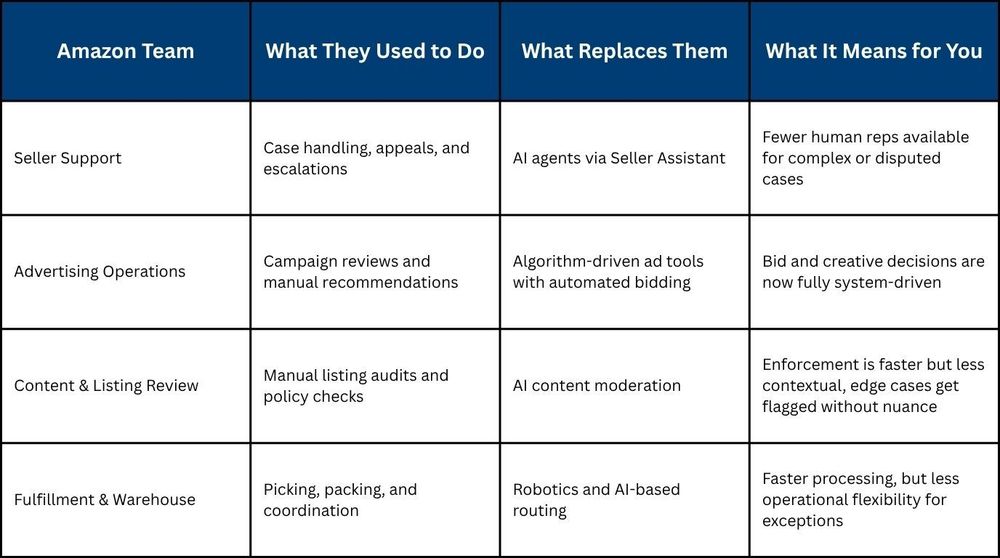
The rise of Amazon AI automation jobs replacing operational roles means the platform is becoming faster and more consistent, but also less forgiving. Systems do not read the context behind an appeal. They process signals and apply rules.
What Does This Mean for Your Day-to-Day as a Seller?
The operational shift inside Amazon is not something sellers will read about in a quarterly report. It is already showing up in case resolution times, ad performance patterns, listing visibility, and fulfillment reliability. Here is what each area looks like right now.
- Will Seller Support Get Worse Before It Gets Better?
Honestly, yes. Right now, Amazon seller support changes mean that when something goes wrong with your account, the first line of response is an AI agent, not a human. Appeals, case reviews, and account flags are increasingly handled by automated systems that work on rules, not context.
Amazon's Account Health dashboard shows this in real time, suspensions go up faster, and getting a human to review your situation takes longer than it used to.
- How Are Advertising Algorithms Changing?
Amazon's ad auctions now adjust every hour, not every day. If you are still reviewing and updating bids manually, you are already behind by the time you log in.
The impact of Amazon AI on sellers running campaigns without automation is real: the system is making placement and bidding decisions around the clock, and manual management simply cannot keep up with that pace. Sellers who want to stay on top of these changes can start by learning how to monitor Amazon ads performance more effectively.
- How Is Product Discovery Itself Changing?
Amazon's Rufus, its built-in AI shopping assistant, is now used by over 250 million shoppers, and it converts at nearly 60% higher rates than regular search. The catch is that only 22% of products on Amazon's first search page actually show up in what Rufus recommends.
The impact of Amazon AI on sellers with outdated listings is simple, buyers guided by Rufus are not finding them, even if their traditional search rank looks fine.
- What Happens to FBA Operations and Inventory?
Fulfillment is faster now, but also less forgiving. With more robotics and less human involvement inside warehouses, mistakes like mislabeled shipments or missed compliance windows do not get caught and corrected, they get processed as violations.
For sellers managing inventory closely, Amazon workforce reduction and AI automation inside fulfillment means there is less room for error and less human judgment available to sort it out when something goes wrong.
Is Amazon's AI Shift a Threat or a Structural Opportunity?
The honest answer is both, and which one it becomes for your business depends entirely on how quickly you move. Amazon layoffs 2025 did not just reshape Amazon's internal workforce. They signalled a platform that is now built to reward sellers who operate the same way Amazon does, through automation, speed, and data-driven decisions.
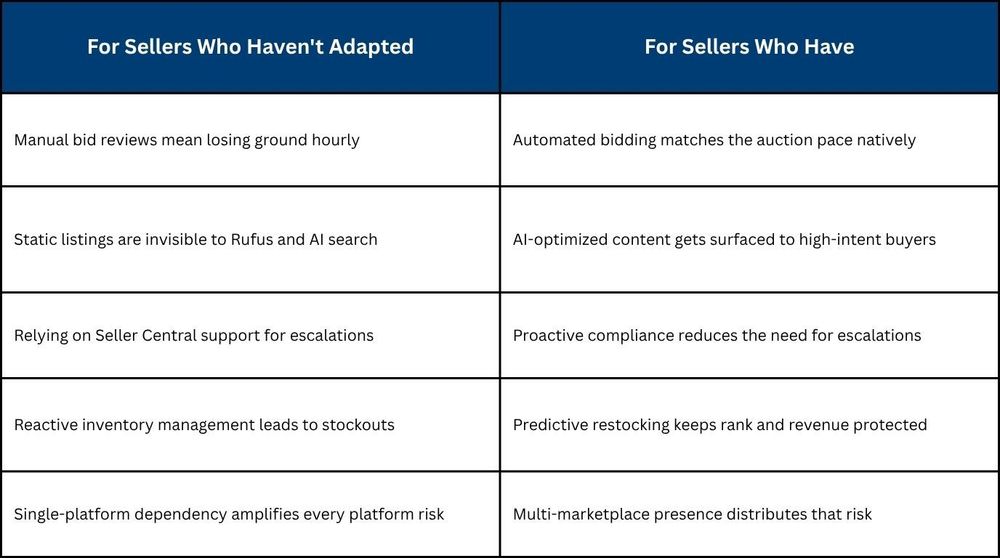
The sellers feeling the most pressure right now are not necessarily the smallest ones. They are the ones still running their Amazon business the way it worked three years ago, checking in weekly, adjusting manually, and waiting for problems to surface before acting.
Amazon's automation strategy 2026 is not a future roadmap. It is already the operating standard. The platform's algorithms set prices, rank listings, serve ads, and flag accounts continuously, and they do not slow down between your check-ins.
What Should Sellers Actually Do Right Now?
The platform has already changed, what needs to catch up is how you operate within it. Sellers who are still running manual processes across ads, listings, and inventory are working against Amazon's current infrastructure, not with it. Here is where to focus first, in line with Amazon workforce reduction AI automation realities.
- Audit your listings for Rufus-readiness: Rewrite your titles, bullets, and descriptions to answer real buyer questions, not just match keywords, because that is exactly how Rufus decides which products to surface.
- Move to real-time ad management: Ad auctions now shift every hour, so if your bids are being reviewed weekly, you are consistently losing impression share to sellers whose campaigns adjust automatically.
- Switch to predictive inventory restocking: Instead of reordering when stock gets low, build your restock triggers around sales velocity and supplier lead times, so you never enter the stockout window that damages rank.
- Build proactive account health habits: With fewer human reviewers available to handle appeals, keeping your account clean upfront is now far more reliable than trying to resolve issues after they are flagged.
- Expand to Walmart marketplace: Diversifying beyond Amazon reduces the risk of any single platform change, an algorithm update, a policy shift, or an account flag affecting your entire revenue.
As Amazon replaces human judgment with automated systems, sellers are facing the same pressure on their side. The real gap now is not tools, it is execution. Who or what is continuously managing your account when the platform itself never slows down?
How Does Xneeti, A New Age AI Platform, Help Sellers Navigate Amazon Workforce Reduction AI Automation?
Amazon has removed much of the human judgment layer from its own operations. The sellers most at risk are those who have not replaced it on their side either, still relying on manual reviews, periodic check-ins, and reactive decisions in an environment that moves on algorithmic time. The impact of Amazon AI on sellers running this way is not sudden, it is a slow erosion of rank, margin, and visibility that is hard to trace back to a single cause.
Xneeti is a multi-marketplace AI platform built by ex-Amazon operators and ex-Google engineers to provide exactly what this environment demands, always-on execution across every part of your account, paired with a human strategist who owns it end to end.
- Dedicated Strategist, Real Attention: Every account gets a dedicated strategist who oversees strategy, communication, and every AI-driven decision, with an account-to-manager ratio 50% lower than the industry standard, so nothing slips through without context or accountability.
- Ads That Run and Adjust Around the Clock: Xneeti's AI adjusts bids by hour, day, and placement level, tracks competitor keywords, eliminates wasted spend through n-gram analysis, manages budget pacing, and integrates with AMC to surface attribution data that Campaign Manager does not show.
- Listings Optimized for Both A10 and Rufus: Content is built to perform in Amazon's core search algorithm and in Rufus, the AI shopping assistant now influencing what 250 million shoppers find, with images generated through Xneeti's own module and reviewed by graphic design before going live.
- Inventory Intelligence That Acts Before Problems Occur: Xneeti's inventory predictor monitors sales velocity, PPC spend rate, and supplier lead times together, flagging reorder recommendations before a stockout window opens and rank takes the hit.
- Payout Clarity on Every Financial Event: Every fee, reserve, reimbursement, and deduction is reconciled and explained in plain language so you always know exactly what landed in your account and what is scheduled for the next cycle.
- Real-Time Account Insights, Without the Wait: Through Insight Intelligence, sellers get plain-English answers to account questions in seconds, no open tickets, no scheduled calls, no waiting on a report that arrives after the moment has passed.
Ready to Run Your Amazon Business on AI?
Amazon's AI shift is not a temporary adjustment, it is a permanent change to how the platform operates, and it will keep moving forward. The Amazon automation strategy 2026 and beyond will continue reducing the human layer inside Amazon, and the sellers who adapt their operations now will find it significantly easier to stay competitive than those who wait for the pressure to become unavoidable.
The question worth sitting with is not whether this shift affects your business, it already does. It is whether your current setup is built to keep pace with a platform that now runs on algorithmic time, around the clock. If the answer is no, Xneeti is worth a closer look, a multi-marketplace AI platform that keeps your ads, listings, inventory, and account health running continuously, the way Amazon itself now operates. Book a demo when you are ready.


