

Running an Amazon business in 2026 should feel different from three years ago. For many sellers, it does not. The bids still need watching, the inventory still needs managing, and the reports still need someone to actually read them. Amazon FBA automation has matured significantly this year, and the gap between what is genuinely possible and what is being oversold has never been more important to understand.
According to Amazon’s official data, independent sellers in the US averaged more than $290,000 in annual sales in 2024, showing that meaningful growth on the platform requires active systems, not passive setups.
AI-native platforms like Xneeti now run continuous automation across ads, inventory, and listings, not as a monthly check-in, but as a system working daily on your account. The sellers building real operational leverage are not automating blindly. They are making deliberate choices about what to hand to AI and what to keep in human hands. This blog breaks down exactly that, so you can confidently automate your Amazon business without losing sight of what is actually driving your growth.
What is Amazon FBA automation?
Amazon FBA automation refers to using software tools, AI platforms, or managed service providers to handle the repetitive operational work in your Amazon business. That covers PPC bid adjustments, inventory reorder alerts, repricing, keyword harvesting, and performance reporting.
Two distinct models fall under this label, and sellers often mix them up.
Software-driven automation - tools that manage specific execution tasks inside your account. You define the rules, the software acts on them, and you keep full control over decisions. These typically run $50 to $500 a month.
Done-for-you (DFY) services - third-party teams that manage part or all of your store for a flat fee, revenue share, or both. You trade hands-on involvement for convenience, and results depend heavily on who you hire.
Underneath both models is Amazon's FBA infrastructure. When you use Fulfillment by Amazon, Amazon stores your inventory, picks and packs orders, ships them to customers, and handles returns. That part is genuinely handled for you. Everything upstream - ads, listings, pricing, product decisions - still requires active management, whether by you, a tool, or an experienced team.
That gap between "fulfillment is handled" and "the whole business runs itself" is where most confusion about Amazon FBA automation begins. Understanding the difference is what separates sellers who build real operational systems from those who hand over control and wait for returns that don't come.
Is Amazon FBA Automation really a passive income business?
No. Amazon FBA is not a passive income business. It is a business that can run more efficiently with the right systems, but it still needs you.
Fulfillment by Amazon takes care of storage, packing, shipping, and returns. That part is genuinely hands-off. But everything that drives the actual performance of your store, your ads, your stock levels, your listings, and your pricing still needs regular attention and smart decisions.
The Amazon FBA passive income myth grew popular because of services promising a fully managed, hands-free store. Many sellers paid large upfront fees for exactly that promise, and ended up with unmonitored accounts, climbing ad costs, and no clear answers. The automation was real. The oversight was not.
According to Amazon's own data, independent sellers in the US averaged over $290,000 in annual sales in 2024. That kind of performance does not happen on autopilot. It happens when the right systems are running, and the right people are watching them.
So when people ask is Amazon FBA passive income, here is the straight answer:
- Fulfillment: Fully handled by Amazon.
- Day-to-day operations: Can be largely automated with the right setup.
- Strategy and decisions: Always human. No tool replaces this.
What are the types of Amazon FBA automation?
Amazon FBA automation is not one thing. It describes a spectrum - how much of the operational work in your business runs on systems versus human effort. Every Amazon seller in 2026 sits somewhere across three levels, and understanding where you are tells you what makes sense to automate next.
The clearest way to understand it is through three layers. Every Amazon business in 2026 sits somewhere across these levels depending on how mature its systems are.
Manual, Assisted, and System Automation
1. Manual Execution
Everything is handled by the seller, including PPC changes, keyword tracking, inventory checks, and reporting. Nothing is automated, and every decision depends on human effort.
2. Assisted Automation
Tools and AI handle repetitive execution like bid adjustments, keyword harvesting, reporting, and budget pacing. Sellers still make decisions, but execution is faster and more stable. Amazon itself already uses automation in its ad system through features like dynamic bidding, where bids are adjusted in real time based on conversion likelihood
3. System-Level Automation
Ads, listings, inventory, and analytics are connected in one continuous loop. AI handles execution in real time while humans focus on strategy, product selection, and profitability control.
Amazon itself reinforces this structure across its ad ecosystem. Sponsored Products campaigns, for example, use automated optimization systems that continuously adjust delivery and bidding based on performance signals and advertiser goals.
This is also where many Amazon automation service models fail. They attempt to automate ownership instead of execution, which leads to systems that run without strategic control.
At a practical level, automation is now strongest in:
- bid optimization
- budget pacing
- search term analysis
- reporting and anomaly detection
But strategic decisions like pricing direction, product positioning, and profitability thresholds remain fully human.
That boundary is what separates controlled scaling from blind automation, and it is the key to understanding how to effectively automate Amazon business operations in 2026.
What Can You Actually Automate in Amazon FBA in 2026?
Yes, a large part of Amazon FBA automation is possible today, but it works best when applied to repetitive execution, not decision-making. The real advantage comes from speeding up tasks that need constant monitoring while keeping control over the direction of your business.
1. PPC Bid Management and Optimization
Automation can adjust bids, manage budgets, and respond to performance signals in real time, especially when supported by structured Amazon PPC ads strategies. Campaign structure, keyword priorities, and budget allocation still depend on human decisions.
2. Keyword Harvesting and Search Term Mining
Systems can extract search term data and surface new keyword opportunities based on performance trends. Deciding which keywords fit your positioning and scaling strategy remains a manual call.
3. Inventory Forecasting and Reordering Alerts
AI can track sales patterns, predict demand, and trigger low-stock alerts before inventory runs out. Supplier coordination and order timing still rely on your cash flow and planning decisions.
4. Reporting and Analytics Dashboards
Automation can generate real-time dashboards and flag unusual changes in performance metrics. Interpreting why those changes happened and deciding what to do next is still a strategic task.
5. Review Monitoring and Basic Customer Responses
Systems can monitor reviews, flag issues, and respond to common queries using templates. Handling sensitive situations, protecting brand tone, and making judgment calls on customer issues cannot be fully automated.
One area worth paying close attention to is listing optimization. Amazon's AI shopping assistant, Rufus, is now a significant part of how shoppers discover and evaluate products. Optimizing only for the A10 algorithm is no longer enough, listings need to be structured for how Rufus reads and surfaces information, too.
Over 250 million customers used Rufus in 2025, with monthly average users up 149% and interactions up 210% year over year. Customers who use Rufus while shopping are over 60% more likely to make a purchase. When asking can Amazon FBA be automated, listings are the clearest example of where AI assists but does not decide.
What Will Never Be Fully Automated, No Matter What You're Sold?
Strategy, judgment, and brand direction are permanently human responsibilities. Even as systems improve, the role of automation is to support decisions, not replace them, when you automate Amazon business operations. Here is what stays in your hands, no matter how advanced the system running your account.
1. Product Selection and Market Validation
Every profitable Amazon business starts with a well-researched product decision. AI can support data analysis, but choices around risk, suppliers, capital, and long-term category direction still depend on you.
2. Pricing Strategy and Margin Control
Rule-based repricers react to competitors and adjust pricing based on set conditions. They do not fully account for your costs, inventory position, or margin limits, which require business context and judgment.
3. Listing Conversion Optimization
AI can surface keywords and draft copy. It does not know why your customer hesitates, what objection your image is failing to answer, or how your offer compares to what the buyer saw ten minutes ago. Conversion is a human problem.
4. PPC Account Structure and Campaign Architecture
Automation works within the campaign structure you create and helps optimise execution over time. The way campaigns are built, segmented, and scaled is still guided by strategic decisions, not automation alone.
5. Brand Differentiation and Creative Direction
Your positioning, your visual identity, and your tone are decisions that require an understanding of your customer and your market that cannot be fed into a workflow. Brand is built by people, not by systems.
Any Amazon automation service that claims full ownership of these areas often reduces visibility into what is actually driving performance. The right systems support execution and provide clarity, but they do not replace control.
What Does a Legitimate Amazon FBA Automation Service Actually Cost?
The cost of automating your Amazon business ranges from $50 a month to $50,000+ upfront, and the gap between those numbers is not just price. It is a fundamentally different relationship with your own business.
Tools and Software — $50 to $500/month
This tier covers PPC automation platforms, inventory alert tools, and analytics dashboards. You stay in full control. Amazon ads software tools execute within the rules you set, and you own every decision. The tradeoff is time, someone still needs to interpret the data, adjust strategy, and act on what the tools surface. Understanding your true cost at this tier starts with knowing your baseline fees, which Amazon's Revenue Calculator can help you map out clearly.
Managed AI Platforms — Mid-Range, Variable by Scope
This is where Amazon FBA automation service cost starts to reflect real operational depth. A platform running AI continuously across ads, inventory, and listings with dedicated account management handling the strategy layer, delivers a different category of output than a tool you log into once a week. The ROI here is strongest when the system is built natively, not assembled from disconnected third-party tools.
DFY Automation Services — $10,000 to $50,000+ Upfront
Done-for-you models typically charge a large upfront fee plus a revenue share. The pitch is full hands-off management. The reality, in many cases, is low transparency, limited seller control over account assets, and deliverables that are difficult to verify. This is the segment of Amazon FBA outsourcing vs automation where the most seller complaints originate, and where due diligence matters most.
Outsourcing vs. Automation: Which Model Actually Fits Where You Are?
Both have a place, but they serve very different stages of a business, and choosing the wrong model at the wrong time is one of the more expensive mistakes an Amazon seller can make.
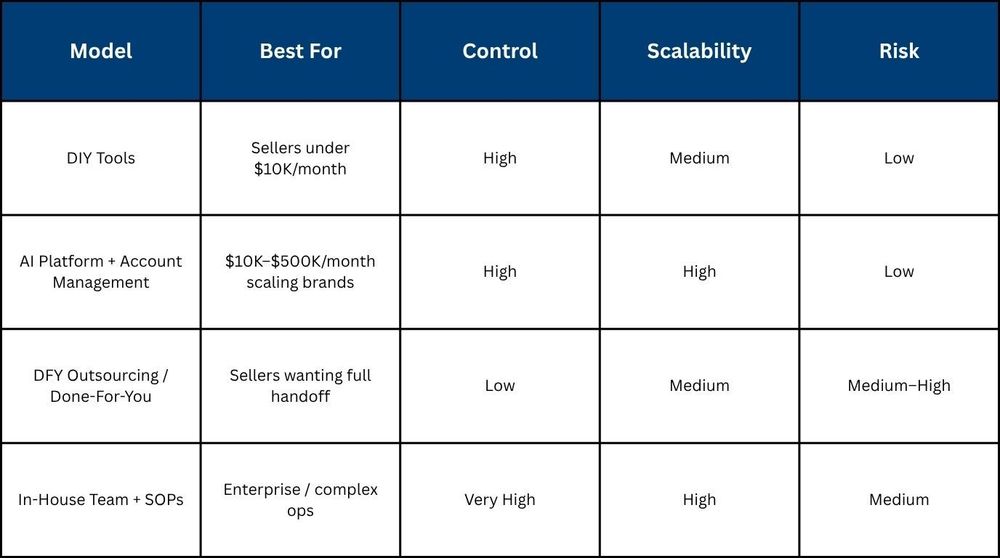
The Amazon FBA outsourcing vs automation decision comes down to one question, do you want someone to take over your business, or do you want a smarter system running it? For brands between $10K and $500K a month, a purpose-built Amazon automation service combining AI execution with a dedicated account strategy consistently outperforms every other model on both control and scalability.
Are You Actually Ready to Automate, Or Are You Just Overwhelmed?
Amazon FBA automation delivers real ROI only when there is enough volume and operational consistency to automate. Below that threshold, it adds cost and complexity without adding clarity.
Run through this checklist before making any automation decision:
- You are spending 10 or more hours a week on repetitive PPC management or reporting tasks
- You are running 3 or more SKUs with consistent, measurable sales velocity
- Your PPC spend is above $3,000 a month, with no clear optimisation cadence in place
- Data is coming in from multiple sources with no unified view of performance
- Decisions are being delayed because reports take too long to compile or interpret
How Does Xneeti Redefine Amazon FBA Automation for Scalable Growth?
Amazon FBA automation delivers real value only when execution runs consistently without breaking strategic control. This is where Xneeti brings a different approach by building a system that works continuously, not in isolated intervals. Instead of relying on a typical Amazon automation service, Xneeti creates a structured environment where AI handles execution while decisions stay aligned with business goals.
1. Built as a Connected System, Not Disconnected Tools
Xneeti operates as a multi-marketplace AI platform where ads, inventory, and listings function within one unified system. This removes the need to manage multiple tools and reduces performance gaps that usually come from fragmented workflows.
2. Execution Runs Continuously While Strategy Stays Human
The platform uses AI agents to manage repetitive execution across campaigns and operations in real time. At the same time, strategic decisions remain with experienced operators, ensuring automation supports growth instead of replacing judgment.
3. Controlled Automation Without Losing Visibility
Xneeti focuses on structured automation where every action is trackable and tied to performance outcomes. This avoids the common risks seen in Amazon FBA outsourcing vs automation models, where sellers lose clarity and control over their accounts.
4. Built Natively for Faster and More Stable Scaling
Because the system is built in-house, it processes data across ads, inventory, and listings without delays from third-party tools. This leads to faster adjustments, more stable performance, and a scalable setup that does not depend on increasing manual effort.
Rethink How You Scale on Amazon
Amazon FBA automation works best when it is treated as a lever, not a shortcut. The goal is not to remove yourself from the business, but to remove the repetition that slows you down. Sellers who scale consistently are not the ones automating everything, but the ones who understand what to automate and what to control.
Platforms like Xneeti are built around this exact balance, where execution runs continuously, and strategy stays in the right hands. If your goal is to automate your Amazon business without losing visibility or direction, the next step is choosing a system designed for that. Book a demo with Xneeti and see how controlled automation can actually scale your business.


