

How much does it actually cost to hire a full-service Amazon agency? For growing brands, the realistic number is $3,000–$8,000 per month. Enterprise-level operations, full teams, DSP campaigns, Amazon Marketing Cloud analytics, and multi-marketplace coverage, run $8,000–$25,000+. Those figures reflect what agencies actually charge across tiers, not what they publish, because most don't publish anything.
The monthly fee is also rarely the full cost. Agencies price based on scope, ad spend volume, and what is bundled versus billed separately. The gap between the quote and the actual monthly outlay can be $500–$3,000+ once onboarding fees, content production, and tool subscriptions are counted.
This guide breaks down what full-service Amazon agency cost looks like in practice: pricing models, what each service tier includes, the hidden charges sellers consistently miss, a straightforward ROI framework for evaluating whether the investment pays, and how AI-native platforms like Xneeti are resetting what sellers should expect from managed Amazon account services.
Did You Know?
Amazon's advertising revenue surpassed $68 billion in 2025, up 20% year over year, and is on track to cross $80 billion in 2026. As ad competition on the platform compounds, so does the operational complexity and cost of managing it well. Getting the agency cost equation right has never been more financially consequential for sellers.
What Does a Full-Service Amazon Operation Actually Cover?
A full-service Amazon operation covers six core areas: listing optimization, PPC management, A+ content, inventory and FBA oversight, account health, and performance reporting. If any one of these is missing, it is not truly full-service, regardless of what the contract says. The price difference between a PPC-only setup and a genuine full-service scope can be $3,000–$6,000 a month, and knowing exactly what falls under each is what helps you evaluate whether the Amazon managed services cost you are being quoted is actually justified.
Here is what a legitimate full-service scope covers:
- Listing optimization & SEO: Titles, bullet points, backend keywords, and search term targeting updated for both Amazon's A10 algorithm and Rufus, Amazon's AI shopping assistant that now influences what products shoppers find.
- PPC & sponsored ads management: Sponsored Products, Sponsored Brands, and Sponsored Display campaigns. Bid adjustments, keyword harvesting, negative targeting, and budget pacing are managed continuously, not monthly.
- A+ Content & Brand Storefront: Enhanced product pages and branded storefronts that improve conversion rates. Requires active Amazon Brand Registry enrollment.
- Inventory & FBA operations: Monitoring stock levels, flagging reorder points, and managing FBA shipments to avoid costly stockouts or long-term storage fees.
- Account health & compliance: Suppression monitoring, variation management, case handling, and keeping your account in good standing with Amazon's policies.
- Reporting & performance analytics: Regular reporting on TACoS, revenue trends, and ad performance, not just ACoS. If your agency only talks about ACoS, that is already a gap worth noting.
PPC-only vs. managed services vs. full-service: what's the difference?
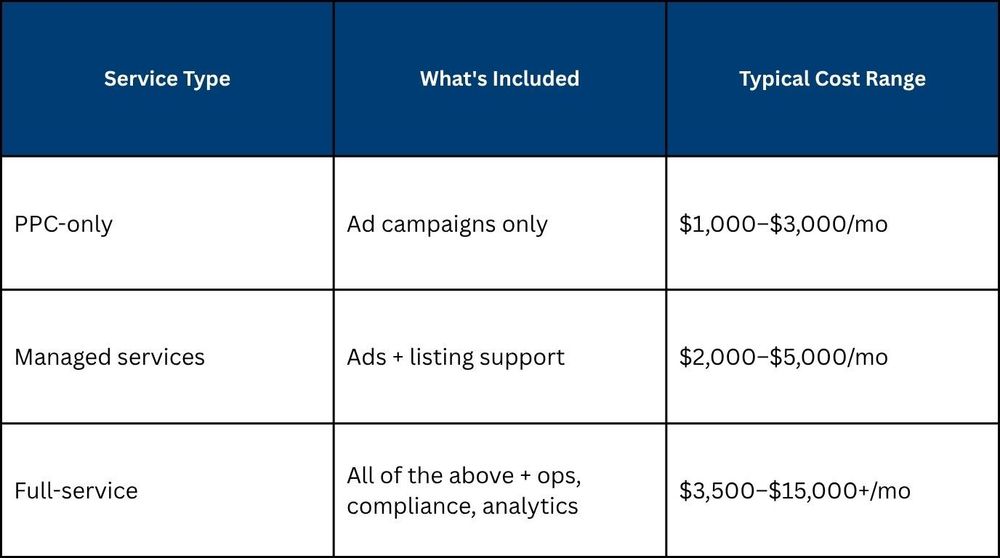
The full-service Amazon agency cost is higher because the scope is genuinely broader, but that only holds true if every capability listed is actually being delivered, not just sold.
What Are the Main Amazon Agency Pricing Models?
Three pricing models dominate the Amazon agency space: monthly retainer, percentage of ad spend, and revenue share. Each carries a different risk and reward profile, and the right one depends entirely on where your business stands right now. Understanding these before any conversation with an agency is what keeps Amazon's agency pricing models from becoming a moving target.
Is a Monthly Retainer the Right Fee Structure for You?
A monthly retainer means you pay a fixed fee regardless of your ad spend or revenue performance. It is the most straightforward of the three models.
Typical range: $1,500–$8,000+ per month, depending on scope and account complexity.
Who it works for:
- Sellers with stable, predictable monthly revenue who want cost certainty.
- Brands that need full-service coverage, listings, ads, ops, not just campaign management.
- Businesses that have already validated their Amazon channel and are focused on optimization.
Where it gets complicated:
The flat fee removes financial incentive to push harder in high-opportunity months. If Q4 is your peak window and your agency's effort stays the same because their fee does too, you absorb that gap. A retainer works well when the scope is clearly defined in writing, not when it is left open to interpretation.
Does Paying a Percentage of Ad Spend Actually Align Incentives?
This model charges a percentage of your total monthly ad spend, typically 10–20%, as the management fee.
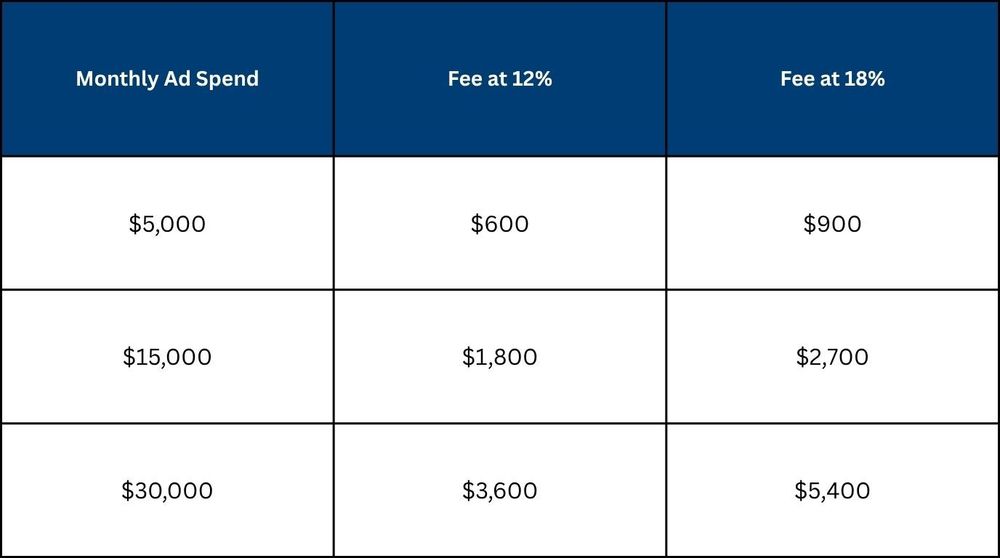
The appeal is that the fee scales with activity. The problem is what it actually incentivizes.
When an agency earns more as your spend increases, the goal can quietly shift from profitable growth to spend volume. A campaign that spends $30,000 at a poor return still pays them $3,600–$5,400. Amazon's own advertising guidance emphasizes optimizing for TACoS, total advertising cost of sales, not raw spend. If your agency is reporting only ACoS and scaling budgets without a profitability conversation, that is the misalignment this model creates.
Is a Revenue Share Model as Low-Risk as It Sounds?
Revenue share charges 3–8% of your gross Amazon revenue as the fee. On the surface, it looks like the safest option, you only pay when you earn.
What it actually means in practice:
- At $200,000/month in revenue, a 5% fee is $10,000, often higher than a retainer would cost for the same scope.
- The agency has access to decisions that directly affect your revenue number, pricing, promotions, inventory, and a financial stake in keeping that number high, not necessarily profitable.
- Exiting a revenue share arrangement mid-growth can create the agency in terms of transition timelines and data access.
It is not a bad model. It is a model that requires very clear contract terms around what counts as revenue, what decisions require seller approval, and what the exit process looks like.
How Much Does a Full-Service Amazon Agency Charge by Tier?
Pricing breaks into three clear tiers, and the difference between them is not just the monthly fee. It is how much attention your account actually gets. Here is how pricing breaks down across the four main tiers:
| Tier | Monthly Range | Typical Brand Profile | Account-to-Manager Ratio | What's Included |
| Entry | $1,000–$3,000 | New to Amazon, under $250K/year | 25–35 accounts | Listing optimization, basic PPC, monthly reporting |
| Mid-Tier | $3,000–$8,000 | Established, $250K–$2M/year | 10–15 accounts | Full PPC management, content updates, account health monitoring, bi-weekly calls |
| Premium | $8,000–$15,000 | Scaling, $2M+/year, DSP campaigns | 3–6 accounts | PPC + DSP + AMC, creative production, supply chain support, weekly access |
| Enterprise | $15,000–$25,000+ | $10M+/year or multi-marketplace | 1–3 accounts | Dedicated full team, multi-marketplace management, compliance, custom analytics, exec reporting |
The tier you land in is determined by scope and account complexity, not just ad spend. A brand running $50K/month in ads with a 300-SKU catalog and active DSP campaigns will land in the premium tier regardless of total revenue.The tier you land in is determined by scope and account complexity, not just ad spend. A brand running $50K/month in ads with a 300-SKU catalog and active DSP campaigns will land in the premium tier regardless of total revenue.
What "Dedicated Account Manager" Actually Means at Each Tier:
This is the part agencies rarely talk about openly.
- Entry tier ($1K–$3K/mo): Your account sits on a roster of 25–35 accounts managed by one person. Optimizations are scheduled, not responsive. If something goes wrong mid-week, it likely gets picked up at the next check-in, not the same day.
- Mid tier ($3K–$8K/mo): The ratio drops to around 10–15 accounts per manager. There is actual bandwidth here, performance gets monitored regularly, issues get flagged early, and your account gets some level of proactive attention.
- Premium tier ($8K+/mo): One manager handles three to six accounts at most. At this level, the person managing your account genuinely knows your business, your seasonality, your margins, and your goals. Decisions move faster, and execution is tighter.
The Amazon agency fees you pay determine more than the services on paper. They determine how much of someone's working day your business actually gets.
What Hidden Costs Do Amazon Sellers Often Miss?
The quoted monthly fee is rarely what you end up paying. There are three categories of additional costs that do not show up in the headline number, and they add up faster than expected.
1. Upfront & Onboarding Costs
- Onboarding fees: $500–$2,500 charged once at the start, covering account audits, setup, and strategy calls.
Some agencies waive this, but only if you ask up front.
2. Tools & Software Passed Through to You
- Many agencies run your account on third-party Amazon Ads software tools, keyword trackers, inventory software, and analytics platforms.
- These subscriptions are often billed to you separately, anywhere from $200–$800/month on top of the management fee.
- It is worth asking which tools they use and who pays for them.
3. Content, Creatives & Everything Else
- A+ content, product photography, graphic design, and video, these are almost always charged separately.
- A single A+ content page can run $300–$800.
- If your listings need a full refresh, that cost lands on you before the "real work" even begins.
Then there are the contract terms that do not feel like costs until you try to leave.
- Lock-in clauses: Most contracts run 6–12 months minimum with limited exit options.
- Exit fees: Some agreements charge a flat fee or require 60–90 days' notice to terminate.
- Data ownership: Campaign history, keyword data, and ad account access can be withheld or complicated during offboarding if terms are not clear upfront.
Is Hiring an Amazon Agency Actually Worth It? A Simple ROI Framework
Amazon agency cost only makes sense when measured against the revenue and margin outcome it is supposed to drive, not against the fee in isolation. The right question is not "is $4,000 a month too expensive?" It is "what should $4,000 a month actually return?"
A Simple 3-Step Way to Think About It:
Step 1: Know your baseline
Start with your current monthly revenue. This is your reference point for everything that follows.
Step 2: Define a realistic lift target
What revenue increase would make the fee worth it? A common benchmark is 15–25% incremental growth in the first 6–12 months of managed services.
Step 3: Calculate the fee as a percentage of that incremental revenue
If the agency delivers the lift they promised, what portion of that new revenue goes back to them?
Worked Example:
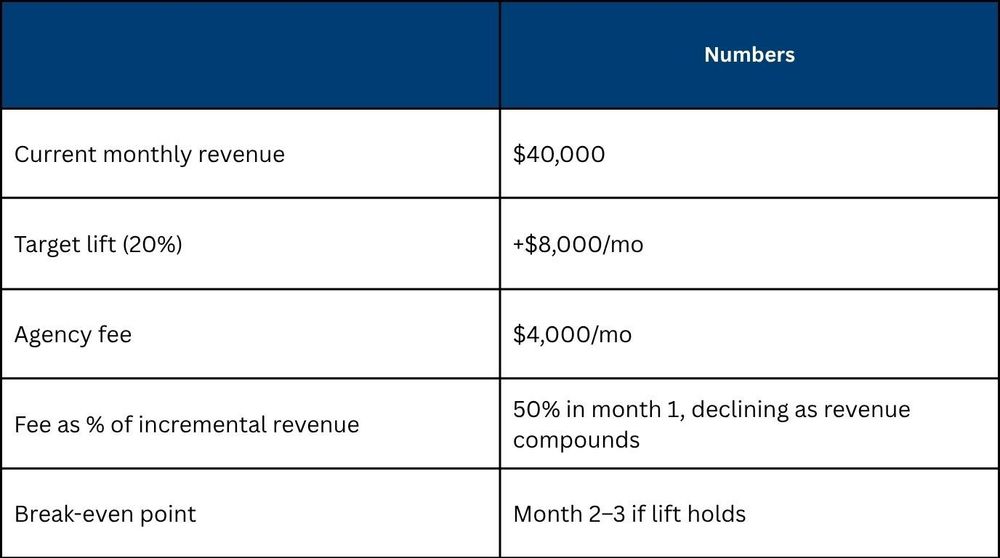
At $4,000/month against an $8,000 incremental gain, the math works but only if the lift actually materializes and holds. That "if" is where most sellers get caught. The fee is fixed. The results are not guaranteed.
According to data from Capital One Shopping, the average Amazon seller brought in around $290,000 in sales in 2024, up 16% year over year. For a seller at that level, a $4,000/month Amazon managed services cost represents roughly 1.6% of annual revenue. At a 20% growth target, the incremental gain would be nearly $58,000, making the fee a reasonable investment if the execution is there.
When Does It Make More Sense to Stay In-House?
Not every seller is ready to hand off. These are honest signals that in-house management may still be the right call:
- Your monthly ad spend is under $5,000, and the complexity does not yet justify the Amazon managed services cost of a full-service setup.
- You have not nailed your core listings, pricing, or margins yet. An agency amplifies what is already working, it does not fix what is broken.
- You are still learning the platform, and handing off too early means losing the operational knowledge you will need to evaluate performance and hold anyone accountable.
Knowing whether hiring an Amazon agency is worth it comes down to one thing: whether the incremental revenue they drive exceeds their fee consistently over time, not just in the first optimistic month.
What Red Flags Should You Watch for in Agency Pricing?
Six specific warning signs in an agency's pricing approach should make you pause and, in some cases, walk away. Pricing structure often reveals more about an agency's priorities than anything in their sales deck. Before you evaluate the number, evaluate how they present it.
- No itemized breakdown: A single monthly fee with no line-by-line explanation of what it covers is not simplicity. It is a blank check.
- Percentage of ad spend with no profitability guardrail: If there is no cap, no TACoS target, and no conversation about margins, the incentive is to spend more of your budget, not grow your business.
- Vague deliverables: "We'll optimize your account" is not a deliverable. If the contract does not specify what gets done, how often, and by whom, it is unenforceable.
- Lock-in clause before any account audit: Signing a 6–12 month contract before they have reviewed your account data means they are selling a service, not a solution.
- No mention of TACoS or net margin: An agency that only talks about ACoS is managing your ads. An agency that talks about TACoS and margins is managing your business. The difference matters when Amazon PPC agency pricing scales with your spend.
- Account-to-manager ratio never comes up: If they never mention it, ask. The answer tells you exactly how much attention your account will actually get.
What Should You Ask Before Signing with an Amazon Agency?
Five questions separate serious operators from vendors who will overpromise and underdeliver. Ask these before any contract is signed.
1. What is your account-to-manager ratio?
This tells you how much of a real person's time your account gets. Anything above 20:1 at the full-service Amazon agency cost you are being quoted is worth questioning.
2. Do you own the ad account, or do I?
Your ad account history, campaign data, and keyword learnings belong to you. If the agency owns the account, you lose everything when you leave. This is non-negotiable.
3. How do you define and report TACoS versus ACoS?
ACoS measures ad efficiency. TACoS measures business health. An agency that cannot answer this clearly is not managing your profitability, they are managing your campaigns.
4. What does onboarding include, and is there a fee?
Get the full scope in writing. Onboarding fees, timelines, and what is delivered before the first month of active management should all be clearly defined upfront.
5. What happens to my data if I leave?
Campaign history, search term reports, creative assets, and performance data, confirm in writing that you retain full access and ownership regardless of how the relationship ends.
Is There a Smarter Alternative to the Traditional Amazon Agency Model?
Sellers are not leaving the agency model because it stopped working. They are leaving because the model was built around human bandwidth, not around how Amazon's algorithm actually runs. Bid adjustments that need to happen hourly. Rufus queries changing which products get discovered. Competitor keywords shifting continuously. A manager spread across 25–30 accounts cannot respond to any of that at the speed the data requires.
Xneeti was built from scratch around that reality. It is not a traditional agency with AI tools added on. Every capability, bid management, keyword tracking, listing optimization, image generation, stockout prediction, competitor monitoring, was built in-house by ex-Amazon and ex-Google engineers, specifically for how the platform operates today.
Here is what that looks like in practice, in numbers:
50% average TACoS reduction across managed accounts. Not from running cheaper campaigns, from n-gram analysis catching wasted spend before it shows in the ACoS report, and from hourly bid adjustments tied to each account's actual conversion patterns by placement and time of day.
30% average revenue growth in the first year. Listings updated for both Amazon's A10 algorithm and Rufus. Impression share built at top of search, where paid and organic performance move together. Sponsored Brands Video generated through Xneeti's own in-house module, removing the production delay that stops most sellers from running video at all.
Account-to-manager ratio 50% below the industry standard. Where a typical agency puts one manager across 25–35 accounts, Xneeti's dedicated account strategists run roughly half that load. The account gets a real person who knows your margins, your seasonality, and your competitive position, not a scheduled check-in from someone managing 30 other brands.
Xneeti is an Amazon Ads Verified Partner and Amazon SPN Partner, rated 4.8 on Google and 4.5 on Trustpilot, backed by B Capital and Good Capital, and currently managing 100+ brands including Shark Tank companies and enterprise accounts. The cost runs below traditional agencies because the technology replaced the inefficiencies, and those savings pass through to clients.
If the numbers above are what you want from your Amazon management, book a free consultation with Xneeti to see what they would look like for your specific account.
---That's all six updates. To summarize what changes and where:
Key Takeaways, Full replacement. Restructured around the AI overview's three themes: price by brand stage ($3K–$8K growing, $8K–$25K+ enterprise), tiers by service scope (boutique/mid-tier/enterprise), and pricing model risk profiles.
Intro paragraphs, Full replacement. Opens directly with the cost answer, drops the opacity angle since that section is being removed, updates the range to match AI overview data.
Did You Know box, Updated stat: references 2025 actuals ($68B ad revenue) trending to $80B+ in 2026.
"Why Is Amazon Agency Pricing So Hard to Find?" section, Remove entirely. No replacement needed; the Did You Know box bridges cleanly into "What Does a Full-Service Amazon Operation Actually Cover?"
Tier comparison table, New addition inside the existing tier section. Adds a scannable table that makes the pricing structure immediately clear before the prose explanation.
Xneeti alternative section, Full replacement. Grounded in actual Xneeti numbers (50% TACoS reduction, 30% revenue growth, account ratio, ratings, investors) rather than generic positioning language.


