

More advertisers are bidding for the same clicks than ever before, and Amazon's ad revenue keeps climbing to prove it. That growth doesn't stay abstract, it shows up directly in your CPC.
Ask ten sellers what they pay per click in 2026 and you'll get ten different answers, most landing between $0.90 and $1.20. That range tells you almost nothing useful for planning your own budget. Your real number depends on your category, your product's lifecycle stage, and the job you're asking the campaign to do.
- High competition ($1.50 to $3.00 per click): supplements, electronics, and beauty. Deep-pocketed brands, high order values, and repeat-purchase economics that justify bids well above what a single click returns.
- Medium competition ($0.75 to $1.50 per click): home and kitchen, pet supplies, sports and outdoors. Enough advertisers to make clicks expensive, not enough to make them punishing.
- Low competition (usually under $0.75 per click): industrial, scientific, and specialized B2B. Smaller search volume, fewer sellers running ads, and buyers who search by part number instead of browsing.
How Much Do Amazon Ads Cost?
Amazon ad costs in 2026 are the highest they have ever been, and they are still climbing. The average Amazon ads cost per click ranges between $0.70 and $1.20 across all formats, reflecting an 8–12% year-over-year increase from 2025. For sellers managing multiple campaigns, that rise compounds fast.
Here is what sellers are paying right now:
- Average CPC (all formats): $0.70 and $1.20
- Sponsored Products: The most widely used format, with the lowest average CPC entry point
- Sponsored Brands: Higher visibility, higher cost per click, stronger brand recall
- Amazon DSP: Impression-based pricing, not click-based; works differently from the auction model
- Average daily ad spend per seller: Beginners typically start with $20–$100 a day to test what works, growing brands push that to $100–$500+ as their campaigns mature, and serious sellers often spend well beyond that.
These numbers are averages, your actual Amazon PPC cost per click will shift based on your product category, keyword competition, bidding strategy, and the season you are advertising in.
Amazon Sponsored ads, including Sponsored Products, Sponsored Brands, and Sponsored Display, all operate on a cost-per-click model, meaning you only pay when a shopper actually clicks your ad.
How Do Amazon Ads Actually Get Priced?
Amazon runs on a second-price auction system, meaning the winner pays just one cent above the second-highest bid, not their own maximum bid. Two sellers bidding $1.50 and $1.20 on the same keyword will result in the winner paying $1.21, not $1.50.
Amazon also factors in ad relevance and listing quality when deciding which ad wins and what it costs. A well-optimized listing can win placement at a lower cost than a higher bid with a weaker listing.
- A new seller bidding $2.00 with a thin listing can lose to a seller bidding $1.40 with strong reviews, optimized copy, and a high CTR history.
- Your Amazon ads average CPC is not just a bidding problem, it is a listing quality problem, too.
- Improving relevance scores is one of the fastest ways to reduce what you actually pay per click without touching your bids.
1. High Competition Categories: $1.50 to $3.00 Per Click
Supplements, electronics, and beauty.
These categories pull in well-funded brands with high average order values, and in supplements, repeat-purchase economics that make a single click worth far more than the first order suggests.
A supplement brand earning $180 in lifetime value from a $45 first purchase can bid $3.00 and still make money. You are not bidding against a keyword. You are bidding against that math.
The second-price auction gives you very little relief here, because the top bids are bunched tightly together. When ten advertisers are all bidding between $2.40 and $2.80, paying one cent above second place still means paying $2.71.
Relevance is the only lever with real force. A listing with a strong CTR history can win the same placement at a materially lower cost, because Amazon is optimizing for revenue per impression rather than bid size.
2. Medium Competition Categories: $0.75 to $1.50 Per Click
Home and kitchen, pet supplies, sports and outdoors.
The spread of bids is much wider here, which is exactly where the second-price auction starts working in your favour. With competing bids scattered from $0.60 to $1.80, winning at one cent above second place often lands well below your ceiling, so setting a higher maximum bid is less dangerous than it looks on the campaign screen.
This tier also rewards listing quality more than any other, simply because the competitive set is uneven. Plenty of sellers in these categories are running thin copy, weak main images, and fewer than 50 reviews. A properly optimized listing can outrank higher bids repeatedly, and the CPC gap compounds across thousands of clicks a month.
3. Low Competition Categories: Usually Under $0.75 Per Click
Industrial and scientific supplies, specialized B2B, replacement parts, technical niches. Fewer advertisers, lower search volume, and buyers who type part numbers and specifications instead of browsing phrases.
The auction is often thin enough that you win at close to your minimum bid. Cost stops being the constraint and volume takes its place. There are simply not enough searches to spend a large daily budget, however much you are willing to pay per click. Sellers here routinely fail to spend their budget, conclude that Amazon ads do not work for their category, and miss that the real problem was keyword coverage, not pricing.
Amazon Ad Cost Breakdown by Format (2026)
Picking the wrong ad format does not just waste budget, it sends traffic to the wrong place at the wrong time. Each format is priced differently because each one does something different. Here is what sellers are actually paying in 2026, broken down by format.
1. Sponsored Products
- Show up in search results and on product detail pages, where most buying decisions get made.
- Shoppers seeing these ads have already typed in what they want to buy.
- Amazon Sponsored Products cost is the lowest entry point across all four formats.
- Bids climb fast on competitive keywords and first-page placements.
- Best for: first-time advertisers, new product launches, and sellers focused purely on conversions.
2. Sponsored Brands
- Your logo, a custom headline, and three products, all sitting above everything else on the search page.
- That top-of-page position is why the price is higher than Sponsored Products.
- Amazon Sponsored Brands cost spikes hardest in Beauty, Supplements, and Electronics.
- Spending $2.00+ per click only makes sense when your listing can actually convert the traffic.
- Best for: sellers with an established catalog who want brand recognition, not just single-product sales.
3. Sponsored Display
- Runs on Amazon product pages, review sections, and across third-party websites outside Amazon.
- Works on both CPC and vCPM, you choose based on whether clicks or impressions matter more.
- Retargeting someone who already looked at your product costs far less than targeting cold audiences.
- The CPC range is wide because targeting options vary significantly in cost and intent level.
- Best for: winning back shoppers who browsed but left without buying.
4. Amazon DSP
- Charges per 1,000 impressions, not per click, a completely different cost structure than the other three formats.
- Comes with a high minimum spend requirement, which puts it out of reach for most sellers who are not yet operating at scale.
- Runs on Amazon's own first-party data, including what shoppers searched, browsed, and bought.
- Ads appear both on Amazon and across the broader web on third-party apps and sites.
- Best for: established brands running full-funnel campaigns who need top-of-funnel reach beyond search.
Amazon CPC by Product Category — What Are Sellers Paying in 2026?
Your product category is one of the biggest cost drivers on Amazon, often more impactful than your bidding strategy alone. High average order value categories attract more advertisers, more aggressive bids, and significantly higher CPCs. Here is what sellers across major categories are paying in 2026.
Figures are 2026 medians across sellers. Your account will sit above or below these depending on listing quality, placement mix, and season.
Clothing and apparel is the line worth staring at. The clicks are cheap and the ACoS is the worst on the board at 57%. A low CPC does not mean low customer acquisition cost when conversion sits near 7% and size and colour variants split your click volume across ASINs that each need their own conversion history before they perform.
Categories like Electronics and Health & Personal Care consistently carry the highest CPCs because the margins are larger and the competition is denser. A supplement brand with 60% margins can afford to outbid most of the category, which forces every other seller to match or lose placement.
Advertisers can evaluate their Sponsored Brands performance relative to peers using Amazon's category benchmark report, covering impressions, CTR, ROAS, and ACoS across specific shopping categories.
5 Factors That Determine What You'll Actually Pay Per Click
Your CPC is not random, it is the output of several compounding variables working simultaneously. Understanding what drives your Amazon ads cost per click up or down gives you far more control than simply adjusting bids.
1. Keyword Competition & Search Volume
Broad, high-volume keywords have more advertisers fighting for the same spot — and that competition has a direct cost. Sellers who shift budget toward long-tail keywords consistently pay less per click and see stronger conversion numbers because the search intent is sharper.
2. Ad Placement — Top of Search vs. Rest of Search vs. Product Page
First-page, top-of-search placements cost more because that is where the most serious buyers are looking. Amazon lets advertisers set bid multipliers anywhere between 0% and 900% per placement type, so budget concentration across all three positions is fully within your control.
Amazon allows advertisers to set placement bid multipliers between 0% and 900% for top-of-search and product page placements, giving sellers direct control over where their budget is concentrated.
3. Your Listing Quality & Relevance Score
Strong copy, quality images, competitive pricing, and solid reviews do more than convert shoppers, they lower what you pay per click. Amazon's algorithm reads relevance signals from your listing itself, meaning two sellers with identical bids can end up paying very different CPCs.
4. Seasonality — Prime Day & Q4 Holiday Spikes
CPCs do not stay flat year-round, Prime Day and the Q4 holiday season routinely push average costs to $1.35–$1.45, a 60–80% jump from baseline. Sellers who treat their ad budget as a fixed number rather than a seasonal variable tend to feel that squeeze hardest when it matters most.
5. Bidding Strategy — Dynamic vs. Fixed vs. Rule-Based
Dynamic bidding adjusts bids in real time based on conversion likelihood, fixed bids stay constant regardless of context, and rule-based bidding allows custom automation triggers. Dynamic bidding down-only is the safest starting point for cost control, it lowers bids when conversion is less likely but never exceeds your set maximum.
What Is a Realistic Amazon Ads Budget for Your Stage?
There is no universal answer to how much you should spend on Amazon ads, but there is a logical starting point based on where you are in your growth journey. Setting a budget without a stage-appropriate benchmark is one of the most common reasons sellers either underinvest and see no results or overinvest and bleed margin before their campaigns are optimized.
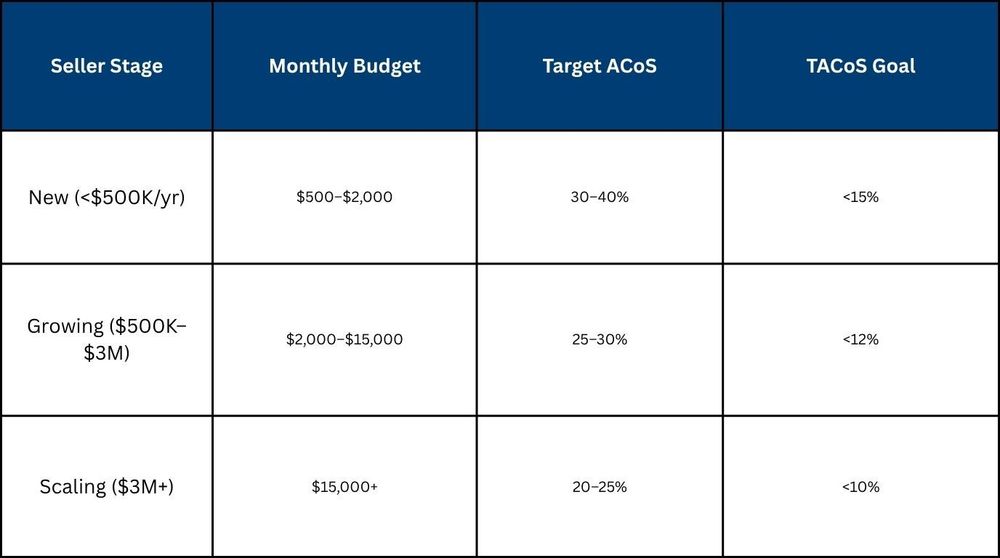
New sellers should prioritize gathering enough click data to optimize campaigns before scaling spend. A minimum of $10–$20 per day is the realistic threshold to collect meaningful performance signals.
Growing sellers in the $500K–$3M range need tighter ACoS discipline as CPCs on core keywords rise. Budget allocation by SKU performance, not gut feel, becomes the deciding factor between profitable scaling and runaway spend.
Scaling brands above $3M are optimizing for TACoS, not just ACoS, where every ad dollar is also an investment in organic rank.
Platforms like Xneeti help brands at this stage map ad budgets directly to TACoS targets across large catalogs, replacing manual guesswork with data-driven allocation.
ACoS, TACoS & ROAS — What Does "Affordable" Actually Mean on Amazon?
Cost alone does not define whether Amazon ads are working. The real measure of affordability is whether your campaigns are generating profitable returns, and that requires tracking the right metrics. Here is what each one means and why it matters.
ACoS (Advertising Cost of Sales) = Ad Spend ÷ Ad Revenue. ACoS compares the amount spent on PPC campaigns to the amount earned, helping determine whether your campaigns are cost-efficient at the campaign level. ACoS represents the ratio of ad spend to promoted product sales for Sponsored Products or overall brand sales for Sponsored Brands and is calculated as ad spend divided by attributed sales.
ROAS (Return on Ad Spend) = Ad Revenue ÷ Ad Spend. ROAS measures how much revenue is earned for every dollar spent on advertising, making it one of the most important metrics for assessing campaign effectiveness and budget decisions.
TACoS (Total Advertising Cost of Sales) = Ad Spend ÷ Total Revenue. TACoS is the metric that tells the full story. Unlike ACoS, which only measures ad-attributed revenue, TACoS accounts for total store revenue, including organic sales. A rising ACoS with a flat or declining TACoS is actually a healthy signal: it means ads are driving organic rank, not just paid sales.
How to Lower Your Amazon Ad Costs Without Cutting Budget
Reducing how much you spend on Amazon ads does not always require spending less, it requires spending smarter. These four levers consistently deliver lower effective CPCs without touching your daily budget caps.
1. Target Long-Tail Keywords
Long-tail keywords average $0.64 CPC compared to $1.18 for broad terms, nearly half the cost with a 13.5% CVR advantage. Shoppers using detailed search terms are closer to purchase, making every click more affordable and more likely to convert.
2. Build a Negative Keyword List
Every irrelevant click you pay for is budget that could have gone toward a shopper who was actually ready to buy. Auditing your Search Term Report weekly and adding irrelevant terms to your negative list is one of the fastest ways to improve ACoS without changing a single bid.
3. Improve CTR to Win Auctions at Lower Bids
Amazon rewards relevance, a higher CTR signals to the algorithm that your ad matches shopper intent, which improves ad rank and lowers effective CPC over time. Your main listing image, title, price point, and review count all directly influence whether that click happens.
4. Limit off-Amazon spend
Check your campaign settings and switch the off-Amazon ad placement option from "increase reach" to "limit off-Amazon spend" to stop wasting money on underperforming external placements.
Is Amazon Advertising Worth the Cost in 2026?
Advertisers using advanced AI-powered tactics have seen up to a 144% lift in full-funnel conversion rate compared to traditional campaigns. Not advertising on Amazon in 2026 is not a neutral decision, it is a visibility disadvantage.
- The market has already voted: US retail media ad spend is projected at $69.33B in 2026, with Amazon commanding ~11% of total global digital ad spend, brands are investing at this scale because the returns justify it.
- The return beats the cost: With an average CVR of 10.2–10.5% versus 1.33% for standard eCommerce, Amazon delivers purchase-ready traffic that most other platforms cannot match.
- The real question is return, not spend: At $1.00–$1.25 average CPC, Amazon ads are not cheap, but cost per acquisition often beats cheaper platforms precisely because of that CVR advantage.
- Fix fundamentals first: If your listing has weak images, uncompetitive pricing, or fewer than 15 reviews, paid traffic will expose those gaps, optimize conversion before scaling ad spend.
How Does Xneeti Help You Control How Much Amazon Ads Cost at Scale?
Managing Amazon advertising cost across a growing catalog is not a spreadsheet problem. It is a systems problem. One that compounds quietly until a monthly report tells you what went wrong three weeks ago. If you have ever wondered how much does Amazon PPC cost and why that number keeps climbing, the answer is almost never the bid. It is everything running underneath it. Xneeti is a natively built AI platform designed by ex-Amazon experts and ex-Google engineers. Built specifically for how Amazon works today, where the auction moves every hour and delayed reactions cost real money. Here is exactly how it works.
1. Hourly Bid Optimization Across Every ASIN: Xneeti's AI engine adjusts bids by hour, day, and placement level. Top of search, rest of search, product pages. All based on your account's actual conversion patterns, not category averages. No manual check-ins, no overnight overspend. No campaigns running on yesterday's data, while today's Amazon ads average CPC has already shifted.
2. TACoS-First Budgeting, Not ACoS Tunnel Vision: Most approaches chase ACoS in isolation. Xneeti looks at the total revenue impact instead. Cutting Amazon ads budget that is quietly driving organic rank is not efficiency. It is self-sabotage. Budget decisions get made based on what profitability actually looks like across the full picture, paid and organic together.
3. Negative Keyword Systems That Run Before the Damage Shows: Irrelevant search terms bleed spend quietly and consistently. If you are tracking how much do Amazon ads cost at the account level, this is often where the answer hides. Xneeti uses n-gram analysis to find patterns silently draining your Amazon sponsored products cost. It adds negatives systematically and closes the leak before it ever appears in your ACoS report.
4. Real-Time Intelligence, Not Monthly Slide Decks: A report that arrives 30 days late is not a decision-making tool. It is a post-mortem. Xneeti gives brand managers live visibility into Amazon PPC cost per click shifts, ACoS movement, and budget pacing. Through Insight Intelligence, you can ask your account anything and get a plain-English answer in seconds.
Final Thoughts
Amazon ads are the most expensive they have ever been, but they also represent the highest-intent traffic available in digital retail today. The brands winning on margin in 2026 are not spending less; they are spending smarter, with cleaner campaign structures, tighter keyword discipline, and real-time visibility into every dollar.
Cost is not the problem. Unmanaged cost is.
Whether you are setting your first Amazon ad budget or scaling campaigns across a hundred ASINs, the difference between profitable growth and wasted spend comes down to how well your systems track, optimize, and respond to performance data in real time.
Ready to find out exactly where your ad spend is leaking and fix it? Book a Demo with Xneeti and get a full audit of your Amazon advertising costs, campaign structure, and TACoS performance.


