

Amazon SEO is the part of marketplace growth that keeps working after you stop paying for it. Ads buy visibility for exactly as long as the budget runs. Organic rank holds position, lowers what you pay per click because Amazon prices relevance into the auction, and compounds as reviews and sales velocity build.
For any brand planning past the next quarter, it is the channel that earns its cost twice.
This makes the tooling decision more consequential than it looks from a pricing page. Keyword databases disagree with each other, sometimes badly.
Reverse ASIN depth varies. Some platforms surface the opportunity and leave every part of the implementation to you. Choose wrong and you can spend a year optimizing toward search terms your customers are not actually typing, with clean dashboards the whole way through.
So we went through the platforms Amazon sellers actually use, compared what each one does well against what it quietly leaves out, and matched them to the stage and workload they suit. Six made the list, and no two of them do the same job.
How Do the Best Amazon SEO Tools Compare?
Tool | Best For | Key Advantage | Starting Price |
Xneeti | AI-first Amazon growth | SEO intelligence with marketplace optimization workflows | Custom |
Helium 10 | All-in-one Amazon operations | Combined SEO, PPC, and listing-management capabilities | Paid Plans |
Jungle Scout | Beginner-friendly workflows | Product and keyword research with operational simplicity | Paid Plans |
SellerApp | SEO plus advertising workflows | Combined marketplace intelligence and PPC visibility | Paid Plans |
SmartScout | Competitor intelligence | Deep seller-level and marketplace visibility | Paid Plans |
MerchantWords | Keyword discovery | Large Amazon keyword database and search intelligence | Paid Plans |
How Did We Choose the Best Amazon SEO Tools?
We started with the searches sellers actually make and the platforms that kept coming up. Then we checked Reddit, Amazon seller communities, and reviews on G2, Capterra, and Trustpilot to see what users were really saying.
That gave us a list of around 15 platforms.
We compared them on the things that matter: keyword database size and data sources, Reverse ASIN depth, listing optimization, reporting, marketplace coverage, and data accuracy. We also looked at what happens after the research. Does the tool just give you a CSV, or does it actually help you improve your listings?
That brought the list down to six. Rather than including a bunch of similar all-in-one tools, we picked platforms that stand out for different use cases: keyword research, competitor intelligence, easy validation, all-in-one functionality, profit optimization, and execution.
Xneeti made the list because its operational integration sets it apart from traditional standalone SEO tools.
Pricing and feature information is based on publicly available data as of May 2026.
Which Amazon SEO Tools Should You Consider in 2026?
Xneeti
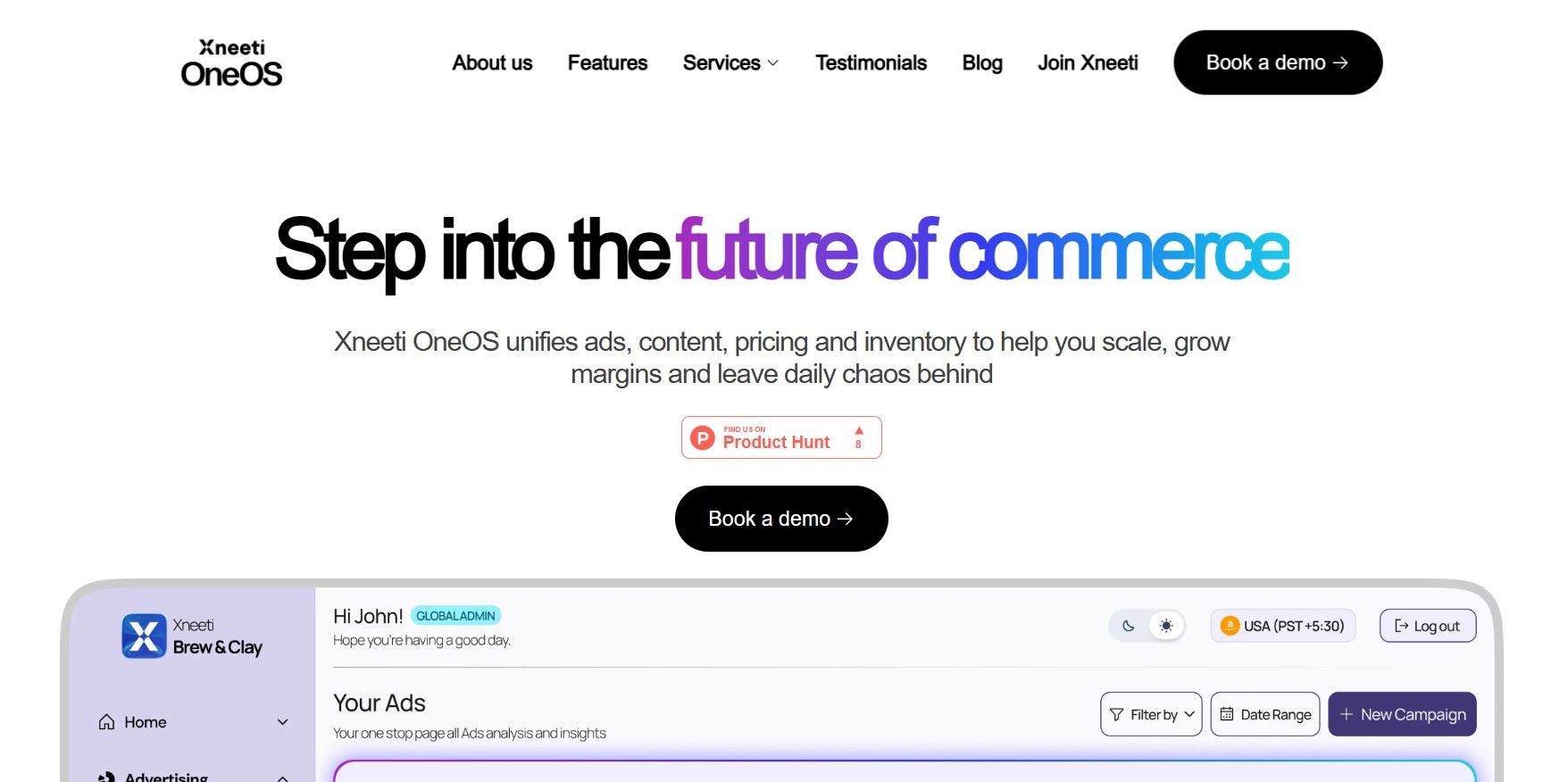
Xneeti is a multi-marketplace AI platform built for brands seeking to scale revenue through integrated marketplace optimization, keyword strategy, and operational execution rather than standalone research dashboards. It is not a tool. It is not a traditional agency.
Built by ex-Amazon category managers and ex-Google engineers, Xneeti helps brands improve rankings and organic visibility by combining advanced keyword intelligence with AI-ready listing optimization, reverse ASIN analysis, and continuous marketplace tracking.
Unlike traditional SEO tools where sellers operate software independently, Xneeti pairs marketplace intelligence with managed strategic oversight. Every account gets a dedicated strategist who owns the business like it is personally theirs, reviewing everything the AI does.
On average, Xneeti accounts see a 50% reduction in TACoS and 30% revenue growth across 80+ managed accounts, including Shark Tank brands and large enterprise sellers. Rated 4.8 on Google and 4.6 on Trustpilot. Amazon Ads Verified Partner and Amazon SPN Partner, backed by B Capital and Good Capital.
Key Features
- Advanced keyword intelligence that reveals true customer search intent and competitive gaps traditional keyword tools miss across categories
- AI-ready listing optimization that surfaces high-impact keywords for natural integration into titles, bullet points, and backend search terms, built for both Amazon's A10 algorithm and Rufus
- Reverse ASIN workflows that identify the exact keyword strategies driving competitor sales, exposing profitable ranking opportunities quickly
- Continuous competitor tracking and marketplace visibility monitoring that catches ranking shifts and seasonal search trend changes in real time
- Search trend analysis identifying emerging customer demand patterns and category shifts before mainstream marketplace saturation occurs
Pros
- Integrates SEO strategy with operational execution so insights translate directly into ranking gains
- Continuous competitor monitoring reveals which positioning strategies actually drive sales in your category
- AI-ready optimization keeps listings aligned with Amazon's evolving algorithm and Rufus discovery
- Dedicated account strategist reviews AI outputs and owns strategy, unlike self-serve software
Cons
- Requires deeper engagement and strategic planning compared to tools where users simply run reports independently
- Custom pricing model means costs depend on marketplace scale, making it less suited for very small sellers testing their first product
- Built for sustained marketplace growth rather than sellers seeking one-time tactical fixes
Pricing
Pricing depends on marketplace scale, catalog size, operational complexity, and managed-service requirements. The cost is lower than a traditional agency because Xneeti built the technology that replaces manual inefficiencies. Book a demo to receive a custom quote based on your specific growth objectives.
Best Use Case
Growth-focused Amazon brands and agencies in the $100,000 to $10 million annual revenue range that have been let down by agencies before and need integrated SEO strategy, competitive benchmarking, and continuous optimization from a dedicated team rather than another research dashboard.
2. Helium 10
Helium 10 is a full-stack Amazon software suite combining product research, keyword intelligence, listing optimization, PPC management, and profitability analytics into a single dashboard for sellers at all business stages.
The platform improves rankings by providing accurate keyword data, listing optimization scoring, and competitor analysis. Mid-sized sellers and agencies needing breadth over specialization get the most from it.
Helium 10's biggest differentiator is feature completeness. Tools like Cerebro and Xray have become industry-standard for competitor keyword analysis and product opportunity evaluation, backed by approximately 71 percent data accuracy coverage.
Key Features
- Cerebro reverse ASIN lookup reveals every keyword a competitor ranks for, both organically and through paid placements
- Frankenstein Keyword Processor combines and filters keyword lists from multiple sources into cohesive targeting strategies
- Listing Analyzer evaluates product listings against ranking best practices, identifying specific optimization gaps
- Market Tracker 360 provides category-wide analysis of pricing trends, inventory patterns, and competitive positioning shifts over time
- Profits analytics calculates true profitability including all Amazon fees, storage costs, and advertising expenses per product
Pros
- Feature breadth eliminates the need for multiple third-party tools, reducing integration complexity and monthly costs
- Data accuracy at approximately 71 percent coverage means decisions rest on reliable marketplace intelligence
- Continuous feature development keeps the platform current with Amazon algorithm changes
Cons
- Feature breadth creates a significant learning curve, requiring training before users operate the platform efficiently
- Pricing escalates quickly across tiers, with Diamond reaching $229 per month billed annually for advanced access
- PPC management features feel less refined compared to specialized Amazon Ads Software platforms
Pricing
Subscription-based tiers start at $29 per month (Starter, billed annually), $79 per month (Platinum), and $229 per month (Diamond). A free tier with limited functionality lets new sellers evaluate the platform before committing.
Best Use Case
Established Amazon sellers and agencies managing multiple accounts or complex product catalogs in the $100,000 to $5 million revenue range who need consolidated marketplace visibility, integrated profitability analysis, and broad feature coverage over specialized depth.
3. Jungle Scout
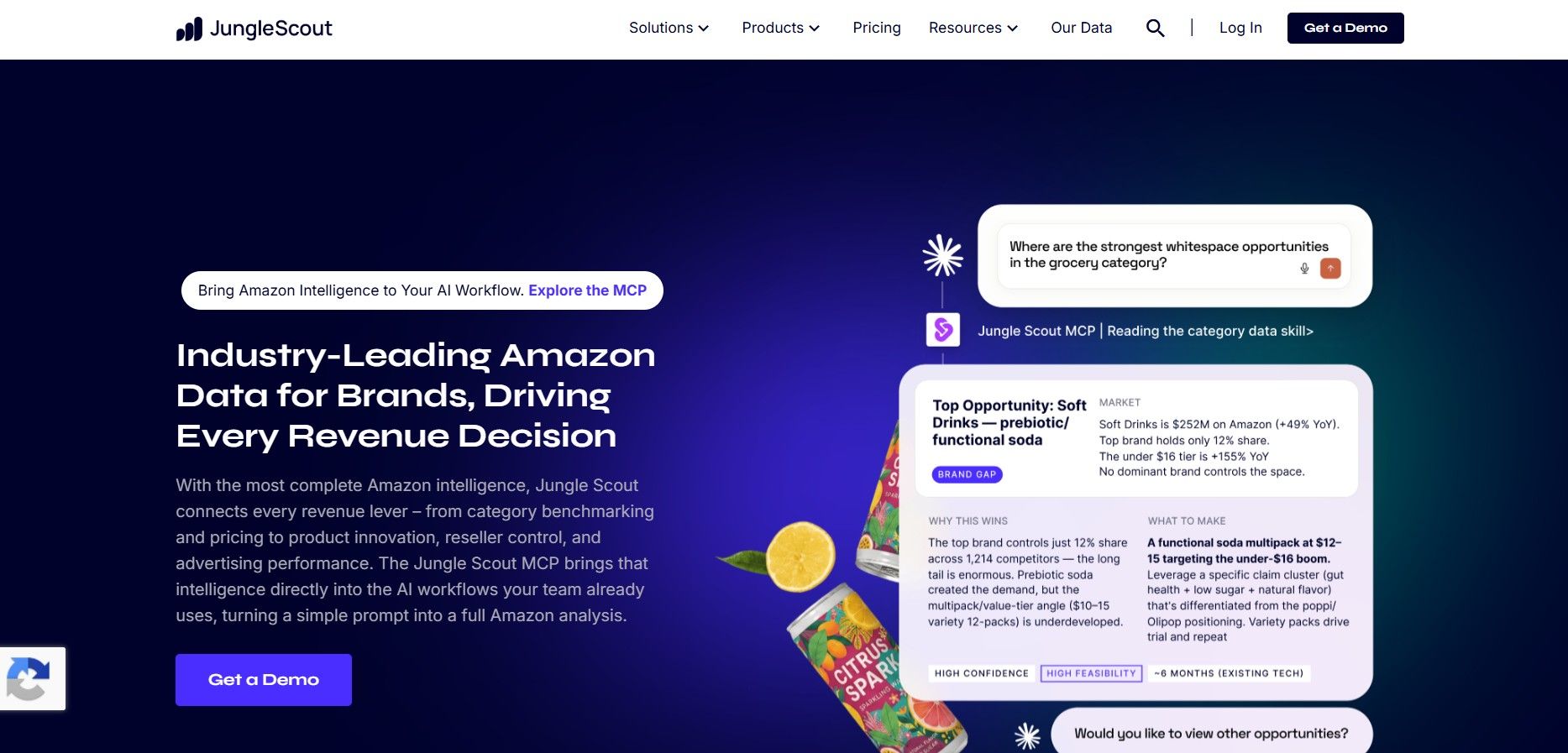
Jungle Scout is a beginner-friendly Amazon research platform that prioritizes product opportunity discovery, keyword research, and competitive analysis through an intuitive interface designed for sellers new to data-driven marketplace analysis.
The platform delivers clear product-level demand insights and straightforward competitive analysis. Newer sellers who value ease of use and quick insights over feature depth benefit most.
Jungle Scout's biggest differentiator is operational simplicity. Keyword Scout provides reverse ASIN lookup in three steps. New users can begin evaluating products within their first session without training.
Key Features
- Keyword Scout simplifies reverse ASIN lookup into a three-step workflow: find competitor ASINs, enter them, collect keywords in seconds
- Product database covers over 475 million products with estimated sales data for rapid opportunity screening across categories
- Niche Hunter identifies emerging opportunities by analyzing category trends, keyword volume patterns, and competitive saturation levels
- Competitor analysis reveals pricing trends, review patterns, and ranking shifts that inform product positioning strategy directly
Pros
- User-friendly interface requires minimal training, enabling sellers to extract insights immediately upon onboarding
- Excels at the initial product research stage where sellers validate demand before committing inventory capital
- Simplified reverse ASIN workflow makes competitive keyword discovery accessible even to first-time sellers
Cons
- Lacks advanced PPC management capabilities, requiring separate tools for Amazon PPC Ads campaign automation
- Data accuracy at approximately 84.1 percent falls behind platforms providing broader product population coverage
- No mobile app functionality limits accessibility for sellers who prefer smartphone-based research workflows
Pricing
Subscription-based pricing with tiered plans. The Catalyst plan covers smaller sellers and new product launches. The Cobalt plan serves established brands and agencies with enterprise-scale analysis, advanced pricing intelligence, and advertising integration.
Best Use Case
New Amazon sellers and resellers in the $0 to $1 million revenue range evaluating first product opportunities who prioritize speed of market validation and simplicity over full-stack marketplace management.
4. SellerApp
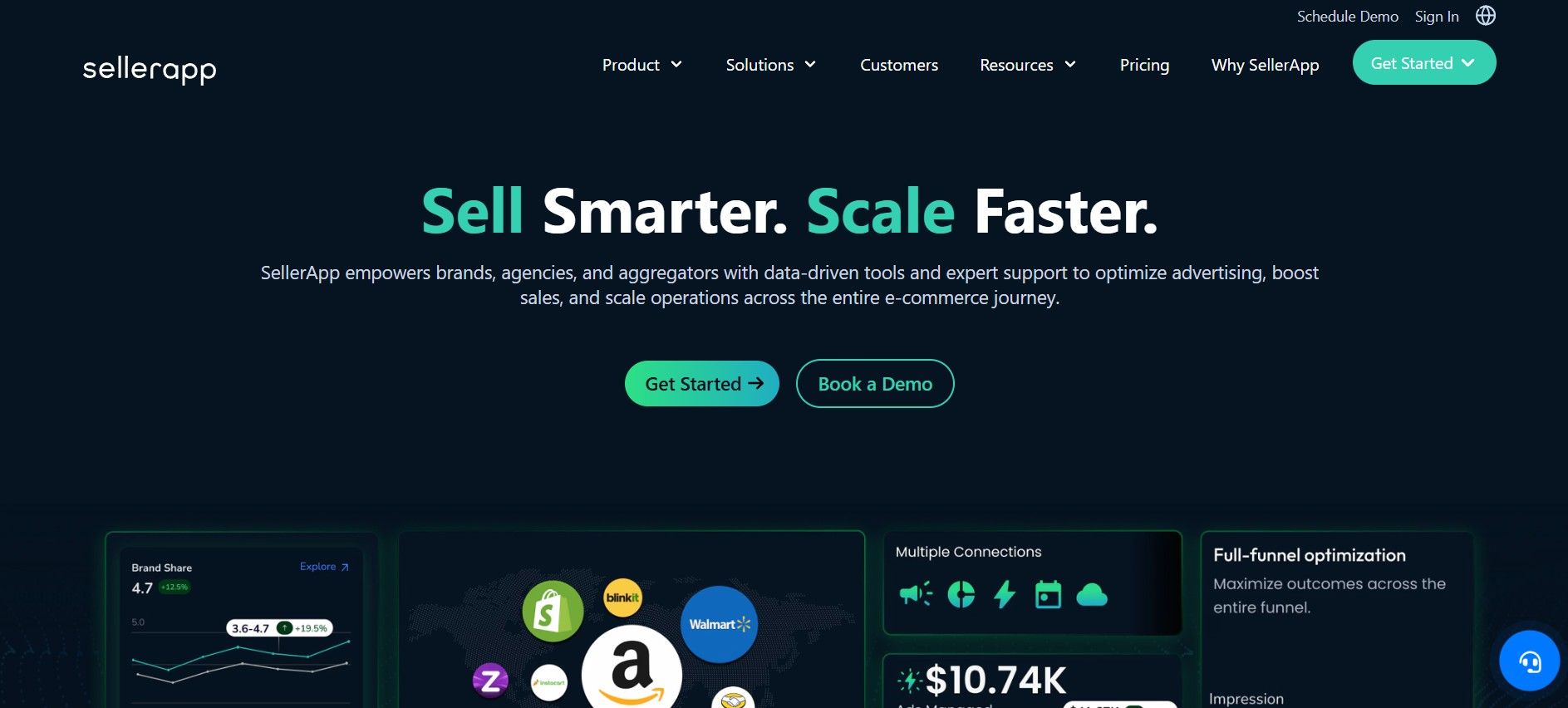
SellerApp is a multi-functional Amazon seller platform combining product research, keyword intelligence, PPC management, and profit analysis. It connects SEO visibility improvements directly to advertising performance and revenue outcomes.
The platform links keyword research with advertising efficiency and profit delivery. Mid-market sellers who recognize that maximum profitability requires optimizing organic rankings and paid performance together get the most from it.
SellerApp's differentiator is its profit-driven approach. Access to over 35 million products with real-time sales estimates, BSR rankings, and FBA fee calculations lets sellers evaluate opportunities by actual profitability rather than surface-level volume.
Key Features
- Product research database providing sales estimates, BSR rankings, FBA fee calculations, and profit margin visibility across Amazon's catalog
- Reverse ASIN lookup reveals competitor keywords and advertising strategies for rapid competitive analysis across product categories
- PPC analytics connect advertising performance directly to keyword-level profitability, showing which paid terms deserve increased investment
- White-label capabilities and multi-account management let agencies serve multiple clients without separate software subscriptions per brand
Pros
- Profit-driven decision making directs every optimization toward actual business economics rather than vanity metrics
- Connection between SEO keywords and PPC performance enables informed bidding decisions based on actual Amazon Ads Cost data
- Agency capabilities scale well for teams managing multiple client accounts across categories and marketplaces
Cons
- Profit calculations can vary from realized profitability due to fulfillment cost variations, storage duration, and return rates
- Interface complexity compared to beginner tools like Jungle Scout requires more onboarding time for new users
- Extracting quick, simple insights can be challenging without filtering and configuration
Pricing
Tiered subscription pricing varies based on tracked accounts, PPC analytics depth, and access to advanced marketplace intelligence features. Custom enterprise pricing is available for larger agencies managing multiple client portfolios.
Best Use Case
Mid-sized sellers and agencies in the $500,000 to $10 million revenue range managing complex product portfolios who need integrated analysis of both organic and paid channels to maximize profitability and Amazon Ads for Scaling Brands performance.
6. SmartScout
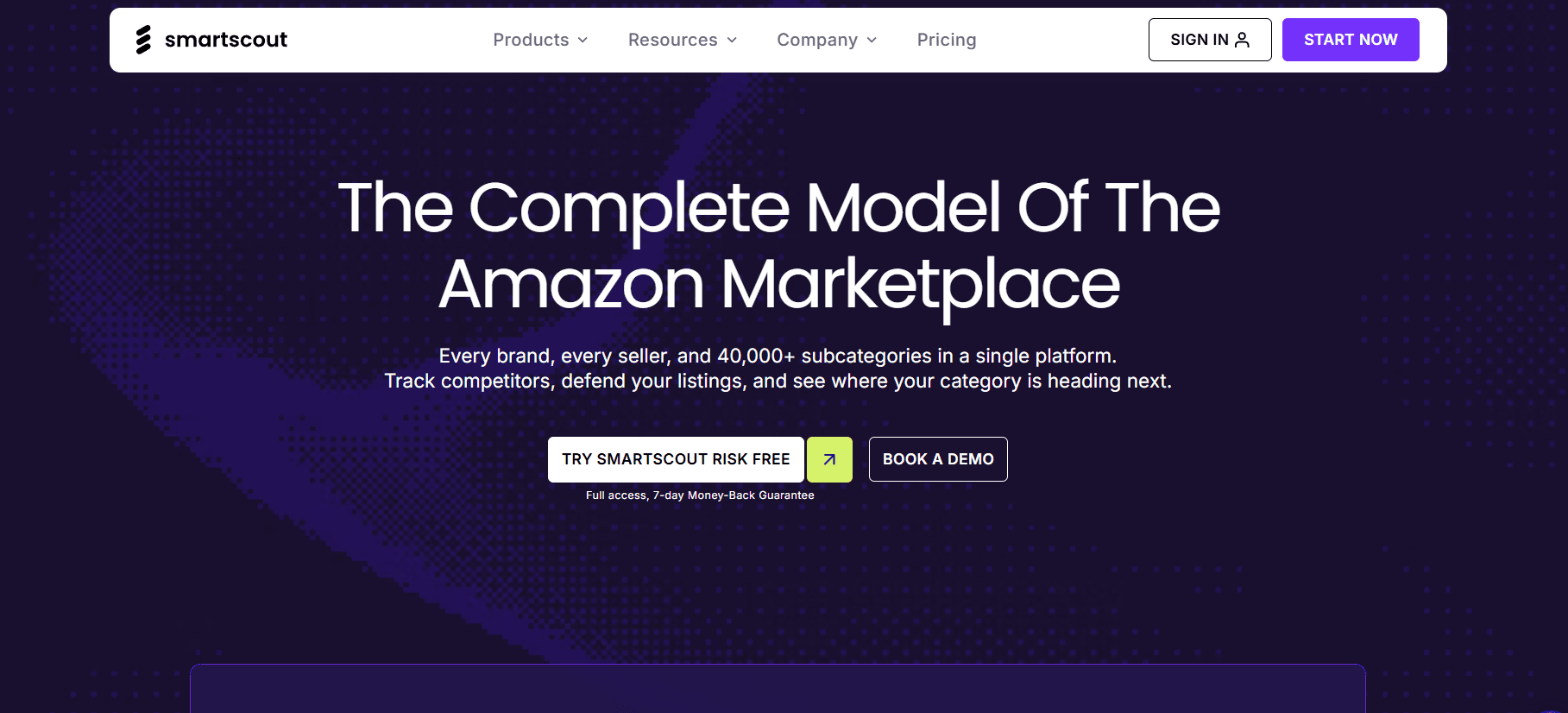
SmartScout is an Amazon marketplace intelligence platform focused on deep seller-level and brand-level competitive analysis. It gives users visibility into competitor positioning, pricing strategy, inventory patterns, and market share across categories.
The platform reveals competitor keyword strategies, ranking patterns, and market positioning that inform SEO refinement. Ambitious sellers who view optimization through a competitive lens rather than internal metrics alone benefit most.
SmartScout's differentiator is brand-level competitive analysis. The platform shows which keywords competitors rank for, how their listings are structured, what pricing strategies they use, and how inventory shifts seasonally.
Key Features
- Reverse ASIN lookup reveals competitor keywords both organically and through paid advertising for rapid competitive strategy reverse-engineering
- Brand Reports analyze entire competitor brands across all products, revealing market positioning, pricing consistency, and portfolio gaps
- Keyword Trends analysis shows search volume and competitive intensity shifts over time for seasonal inventory and promotional timing
- Marketplace visibility dashboard tracks competitor price changes, inventory levels, and Buy Box ownership for rapid competitive response
Pros
- User-friendly interface makes advanced competitive analysis accessible without training or technical expertise
- Brand-level analysis provides strategic context that informs long-term marketplace positioning and product development decisions
- Data accuracy and competitor tracking depth reveal genuine competitive patterns rather than isolated metric snapshots
Cons
- The volume of competitive data can feel overwhelming, potentially creating analysis paralysis for sellers unsure how to act on it
- Less emphasis on internal keyword research capabilities compared to Helium 10 limits standalone optimization value
- Pricing for advanced tiers can be significant for smaller sellers who are just beginning to scale
Pricing
Subscription-based tiers start at $25 per month (Basic), $75 per month (Essentials), $158 per month (Business), with custom Enterprise pricing for large brands and agencies. Costs scale with competitor data depth and number of brands analyzed.
Best Use Case
Ambitious sellers and growing brands in the $500,000 to $10 million revenue range managing intense competitive environments where understanding competitor strategy is required for maintaining market position, especially brands entering new categories or facing aggressive competitors.
7. MerchantWords
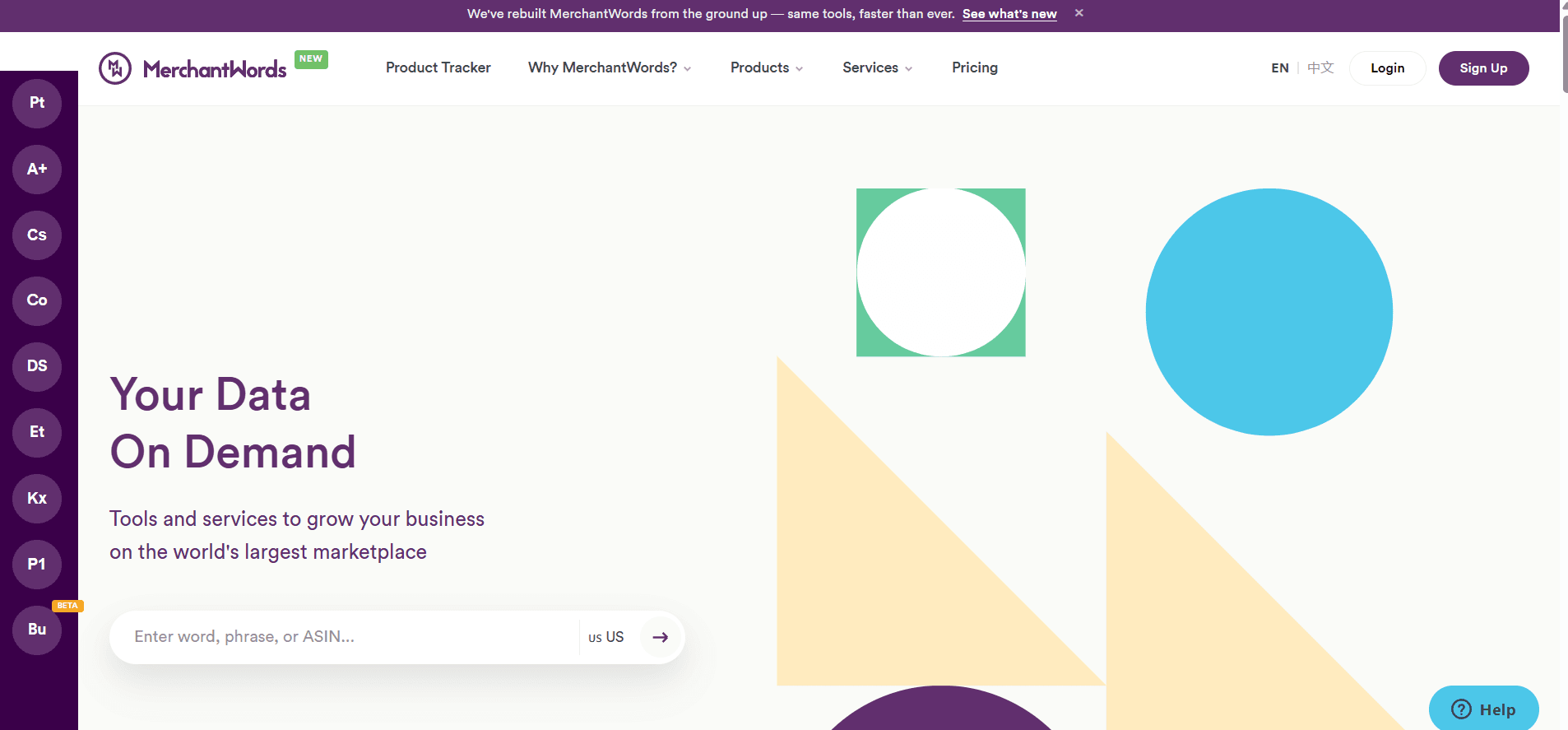
MerchantWords is a dedicated Amazon keyword research platform specializing in massive-scale keyword databases and search intelligence derived directly from Amazon's search bar autocomplete and real-time customer searches across 11 global marketplaces.
The platform captures the exact search terms customers type when shopping. Keyword specialists and agencies building strategies for multiple brands get the most from it.
MerchantWords' differentiator is database scale and recency. Billions of customer search insights captured continuously from Amazon's autocomplete mean emerging search trends surface here before they appear in other analytics platforms.
Key Features
- Billions of customer search insights captured from Amazon's 11 global marketplaces for multi-region keyword research and international expansion
- Search term analytics reveal how customer search behavior shifts seasonally and how new customer preferences emerge over time
- Product opportunity discovery tools identify high-demand, low-competition keyword niches where sellers can establish strong early positioning
- SERP analysis and pricing intelligence provide competitive context around keyword opportunities and market gaps
Pros
- Exceptional database scale provides visibility into genuine customer search behavior rather than approximated or modeled metrics
- Keyword research specialization means extreme analytical depth without dilution from unrelated features
- Multi-marketplace coverage enables sellers pursuing international expansion to research opportunities across Amazon's global presence
Cons
- Lacks advanced listing optimization tools or PPC management features, requiring separate platforms for strategy implementation
- The volume of keyword data can create analysis paralysis if sellers attempt to evaluate all opportunities without strategic filtering
- User interface can feel less modern compared to newer competitors
Pricing
Subscription-based pricing across four tiers: Silver at $35 per month (500 monthly searches), Gold at $79 per month (1,000 searches), Platinum at $149 per month (three user seats, unlimited searches), and Enterprise at $749 per month (20 user seats, unlimited searches).
Best Use Case
Keyword research specialists and agencies building keyword strategies for multiple brands in the $1 million to $10 million revenue range with large product catalogs requiring systematic keyword coverage across hundreds of SKUs, particularly international sellers pursuing marketplace expansion.
What Features Should You Look for in Amazon SEO Tools?
1. Keyword data sourced from actual Amazon searches
Accurate keyword intelligence drives discoverability, but accuracy depends entirely on where the data comes from. A database built from Amazon's search bar autocomplete and real customer queries behaves differently from one built on modeled estimates.
Ask what the source is and what the published accuracy rate is, because the gap between tools here runs to more than ten percentage points. Sellers targeting the terms customers actually type rank higher and pull more qualified traffic than those optimizing for assumed patterns.
2. Reverse ASIN lookup covering organic and paid keywords
Enter a competitor's ASIN, get back the keywords driving their visibility. The versions worth having return both organic and sponsored terms, because a competitor holding position through ad spend is a solvable problem, and one holding it organically is a longer project. Either way, this surfaces profitable ranking opportunities far faster than reading competitor listings by hand.
3. Listing optimization that tells you what to change
Plenty of tools score a listing and stop there. The ones worth paying for name the specific gap: the keyword missing from the title, the backend search field left half empty, the bullet that reads well and ranks for nothing.
Optimized listings lift click-through and conversion, and both feed back into rank, so the instruction is worth more than the score.
4. Brand-level competitor tracking
ASIN-level snapshots tell you what one product is doing. Brand-level analysis shows how a competitor's entire portfolio is structured, priced, and stocked, which is where their strategy is actually visible.
Knowing which keywords drive their sales, where they are weak, and how they price lets you work the gaps rather than copy the approach and inherit its problems.
5. Rank and visibility tracking over time
A single ranking check tells you almost nothing. What you need is the trend: keyword traffic shifting, ranking movement in the weeks after a listing change, seasonal demand patterns, and competitor pressure building before it costs you position.
This is also the only way to know whether an optimization worked, which is the only reliable basis for deciding what to do next.
Why Do Amazon SEO Tools Matter More in 2026?
Amazon's search and product discovery mechanisms are changing rapidly. AI-driven shopping experiences, rising category competition, and ranking algorithms that weigh customer satisfaction signals more heavily than keyword density are reshaping the marketplace.
Sellers relying on outdated SEO workflows struggle with rankings. They pursue generic keyword volume rather than high-conversion terms. They misallocate advertising budgets. They fail to maintain ranking consistency when competitors increase pressure.
Strong Amazon SEO tools improve keyword targeting by revealing which search terms drive highest-converting traffic. They improve listing quality through data-informed iteration. They identify underexploited keywords where demand exists but competition remains light.
Stronger SEO intelligence increasingly determines long-term marketplace growth. Initial rankings trigger positive feedback cycles of traffic, reviews, conversion improvements, and algorithmic ranking boosts that compound over time.
Why Is Xneeti a Strong Amazon SEO Tool Alternative?
Xneeti is built for brands that have moved beyond initial product testing and have been let down by agencies before. These brands need integrated SEO strategy combined with operational execution support to maintain ranking consistency and drive sustainable marketplace revenue.
Xneeti combines SEO intelligence with marketplace optimization workflows and proactive strategic execution. Brands get integrated strategy, competitive benchmarking, and implementation support from a dedicated team of ex-Amazon and ex-Google specialists rather than isolated reporting dashboards.
Xneeti outperforms traditional Amazon SEO tools through AI-ready optimization for both A10 and Rufus, deeper competitor intelligence, faster reverse ASIN workflows, continuous marketplace visibility tracking, and operational execution that turns research into sustained ranking gains. On average, accounts see a 50% reduction in TACoS and 30% revenue growth.
The platform fits ambitious Amazon and Walmart marketplace sellers scaling across multiple categories who need systematic optimization, not periodic one-time SEO efforts. Book a demo to evaluate fit.


