

Amazon’s advertising landscape has changed quickly. Competition is higher, CPCs have climbed steadily, and new discovery systems now influence how shoppers find products. For brands trying to gain visibility in crowded categories, Amazon PPC ads have become more than a traffic tool. They play a direct role in product discovery, sales velocity, and even organic ranking across the marketplace.
In fact, research shows that more than 56% of online shoppers begin their product search directly on Amazon, ahead of search engines like Google. When the buying journey starts inside the marketplace itself, visibility within Amazon search becomes critical for brands competing in busy categories.
Navigating this environment requires more than basic keyword bidding. A modern Amazon PPC ad strategy must consider evolving shopper behaviour, multiple ad formats, and smarter campaign structures that prevent wasted spend. Many growing brands now rely on platforms such as Xneeti to bring clearer performance visibility and structured optimisation to their advertising efforts. This article explains how Amazon PPC ads work in 2026, the ad formats available, and the strategies sellers can use to run campaigns more effectively.
What Is Amazon PPC, And How Do Amazon PPC Ads Actually Work in 2026?
Amazon PPC (Pay-Per-Click) refers to Amazon’s internal advertising model that lets sellers and brands promote products directly on the marketplace. Through Amazon PPC ads, advertisers pay only when a shopper clicks the ad, which makes it a measurable way to bring products into visible positions across search results and product detail pages.
By 2026, Amazon PPC ads run through a real-time auction that takes place every time a shopper enters a search query. At that moment, Amazon evaluates multiple ads and determines which Amazon PPC ad should appear by weighing bid competitiveness together with relevance signals.
Several factors shape this selection process. In practice, Amazon tends to favour ads that combine competitive bids with strong alignment to what the shopper is actually searching for.
Key ranking signals include:
Bid amount – The maximum amount an advertiser is willing to pay for a click.
Relevance to the search query – How closely the product matches what the shopper is searching for.
Product listing quality – Elements such as titles, images, pricing, and overall listing optimisation.
Historical conversion rate – Products that consistently turn clicks into purchases often receive stronger ad placement.
Once campaigns are active, Amazon PPC ads can appear in several placements across the Amazon marketplace.
Common ad placements include:
Top and middle positions within search results
Product detail pages alongside competing listings
Category browsing pages
Retargeting placements through display advertising
Advertising visibility on Amazon often leads directly to purchase decisions. According to Amazon Ads, 59% of surveyed shoppers say they are more likely to make a purchase from an ad they saw on Amazon, highlighting the strong buying intent present on the platform.
Which Amazon PPC Ad Formats Should Sellers Use in 2026?
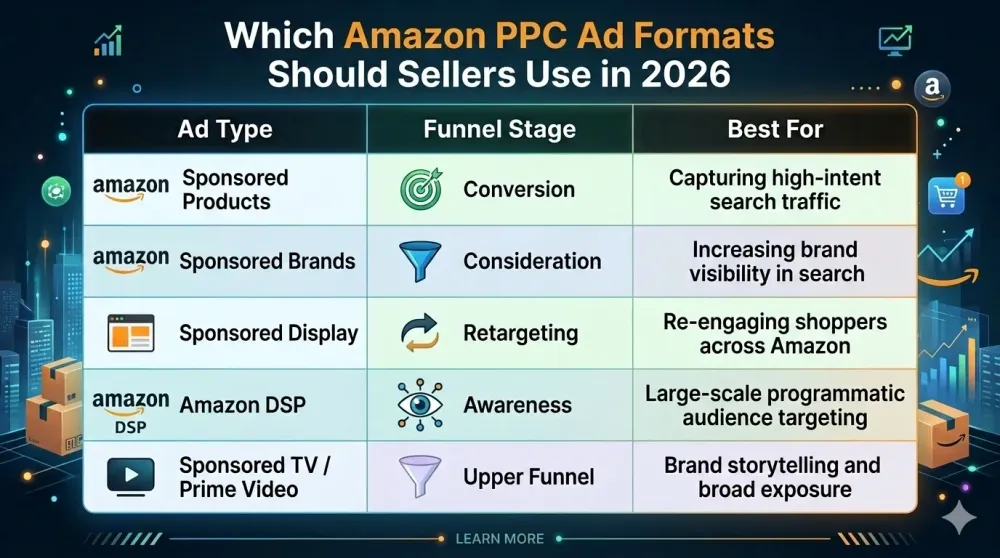
Amazon has four ad formats, and each one operates differently depending on where it appears and how it targets shoppers. Most sellers start with Sponsored Products, but stronger performance usually comes from running multiple formats together - covering discovery, brand presence, and retargeting within a single strategy.
Sponsored Products
Sponsored Products are the most widely used format on Amazon, running across search results pages and product detail pages. They look nearly identical to organic listings, with only a "Sponsored" tag differentiating them. Because they target shoppers who are already searching, they tend to produce the highest direct conversion rates of any ad type.
They support both automatic and manual targeting (covered in the next section), and campaigns can use keyword targeting or product targeting to reach specific ASINs or categories.
Roughly 70% of third-party sellers on Amazon run Sponsored Products as their primary ad format. For most growth-stage brands, this is where the majority of campaign budget should sit.
Sponsored Brands
Sponsored Brands require Brand Registry and appear as a banner at the top of search results - above all organic listings and Sponsored Products. Each ad includes a brand logo, a custom headline, and up to three products.
There are three creative formats to choose from. Product collection promotes a set of individual products and directs clicks to a custom landing page or your Amazon Store. Store spotlight promotes three subcategories within your store, useful for brands with a wider product range. Video ads auto-play directly in search results and typically outperform static creatives in competitive categories where differentiation matters.
Sponsored Brands work best for building category awareness and driving shoppers to your Store rather than a single listing. They are not the right starting point for new sellers with limited brand presence, but they become more valuable once Sponsored Products campaigns are consistently profitable.
Sponsored Display
Sponsored Display targets shoppers based on behaviour rather than search queries. That means your ads can reach people who viewed your product but didn't buy, who browsed a competing product, or who fall within specific audience segments Amazon has built from its shopping data.
Placements appear both on Amazon and off-platform - across third-party websites, apps, and streaming environments. This makes Sponsored Display the only native Amazon ad format with reach outside the marketplace.
Targeting works through two methods. Contextual targeting places your ads on specific product pages or within product categories. Audience targeting lets you retarget past viewers within a 7 to 90-day lookback window, or buyers within a lookback window of up to 365 days.
Most sellers add Sponsored Display after their Sponsored Products campaigns are generating stable data. It is more effective as a retargeting tool than as a first-touch awareness play.
Amazon DSP
Amazon DSP (Demand-Side Platform) is a programmatic buying system that runs advertising outside of the standard self-serve ad console. It gives access to Amazon's full audience data for placements across websites, apps, Fire devices, and streaming services including Freevee.
Unlike Sponsored ads, DSP is not keyword-based. Campaigns are audience-driven, using signals like past purchase behaviour, category browsing, and demographic data. Minimum monthly budgets typically start around $10,000, making it more relevant to established brands than to sellers just starting out.
How does automatic vs manual targeting work in Amazon PPC?
The targeting type you choose determines how Amazon decides which searches trigger your ad. Both options have a specific role in a well-run campaign structure, and most experienced sellers use them together.
Automatic targeting
With automatic targeting, Amazon matches your ad to search queries based on your product listing - the title, description, and category information you have already provided. You don't choose keywords. Amazon decides which searches are relevant.
Automatic campaigns divide their targeting into four groups. Close match shows your ad to shoppers searching with closely related terms. Loose match casts a wider net, including loosely related searches. Substitutes places your ad on product pages for similar products from other brands. Complements places your ad on product pages for items that pair with yours.
This setup is useful at the start of a campaign when you don't have conversion data yet. Run an automatic campaign for at least two to three weeks, then pull the search term report to see which queries actually converted. That data feeds directly into your manual campaigns.
Manual targeting
Manual targeting gives you full control over which keywords or ASINs your ads run against. You set individual bids per keyword, choose the match type, and adjust based on performance over time.
Within manual targeting, there are two approaches. Keyword targeting bids on search terms to appear in results when shoppers use those queries. Product targeting bids on specific ASINs or product categories to place your ad directly on a competitor's or related product's detail page.
The standard workflow most sellers follow: run automatic campaigns to discover what converts, then move those high-performing search terms into manual campaigns as exact match keywords. Add them to the negative keyword list in the automatic campaign at the same time, so both campaigns are not competing against each other for the same query and inflating your CPC.
What are keyword match types in Amazon PPC?
Match types control how closely a shopper's search needs to match your target keyword before your ad is eligible to appear. Choosing the right match type for each keyword is one of the more direct ways to manage CPC and conversion quality.
Broad match
The widest option. Your ad can appear for searches that include variations, synonyms, and related terms - not just the exact phrase. Broad match generates the most impressions and the lowest average CPC, but also the most irrelevant traffic if not monitored carefully. It works well in discovery campaigns where the goal is to identify what your audience actually searches for.
Phrase match
Your ad shows for searches that contain your keyword in the same sequence, with words permitted before or after the phrase. For example, targeting "running shoes" on phrase match would show for "women's running shoes" or "running shoes for flat feet" but not "shoes for running." This gives more control than broad without sacrificing too much reach.
Exact match
Your ad shows only for searches that match your keyword exactly, or very close variants (plurals, misspellings). This is the tightest targeting option and typically produces the highest conversion rate because the shopper intent is predictable. Once a keyword has proven itself in automatic or broad match campaigns, moving it to exact match in a dedicated manual campaign is how most sellers scale spend efficiently.
Negative keywords
Negative keywords stop your ads from appearing on irrelevant searches. They don't generate traffic - they block it. Adding negative keywords is one of the fastest ways to reduce wasted spend without touching your bids.
If you sell high-end supplements, adding "cheap" or "budget" as negative keywords prevents your ads from showing to shoppers who are unlikely to pay your price. Reviewing the search term report weekly and adding low-conversion queries as negatives is a standard optimisation practice that directly affects ACoS.
Negative keywords can be applied at exact or phrase match level, and they can be set at the ad group or campaign level depending on how granular your targeting structure is.
Who Can Run Amazon PPC Ads?
Both new sellers and established brands can use Amazon’s ad platform, but access depends on account type and listing eligibility. Generally, businesses selling through Seller Central or Vendor Central can run Amazon PPC ads provided their listings meet Amazon’s policies and quality standards.
To run an Amazon PPC ad, advertisers typically need to meet the following conditions:
1. Seller Central: This account type is used by third-party sellers who list and sell products directly to customers. From Seller Central, sellers can create and manage Amazon PPC ads to promote listings in search results and on product pages.
2. Vendor Central: Vendor Central is for brands that sell wholesale to Amazon rather than directly to shoppers. Vendors also use Amazon’s ad tools to run campaigns that support visibility and retail demand.
3. Brand Registry: Registering your brand protects your trademark and gives more control over product pages. It’s also required for certain ad formats, for example, Sponsored Brands and some advanced display placements, within an Amazon PPC ad strategy.
4. Active Buy Box: The Buy Box is the primary purchase option on a product page. Only sellers who hold the Buy Box can run Sponsored Products that point directly to that offer.
What Do Amazon PPC Ads Cost in 2026?
The cost of running Amazon PPC ads varies widely depending on product category, competition, and keyword demand. However, advertising costs have increased steadily as more brands compete for the same search placements.
Amazon’s advertising business generated nearly $46.9 billion in revenue in 2023, highlighting the rapid growth in advertiser demand and competition for sponsored placements.
Understanding a few key metrics helps sellers evaluate how efficiently their Amazon PPC ad strategy is performing.
Key Amazon PPC Performance Metrics
CPC - Cost paid for each ad click
ACoS - Advertising efficiency relative to revenue
TACoS - Long-term profitability, including organic sales
Average CPC
Cost-per-click represents the amount advertisers pay when a shopper clicks their ad. In competitive categories such as electronics, beauty, or supplements, CPCs can exceed $1.50, while lower-competition niches may still see clicks below $0.75.
Advertising Cost of Sale (ACoS)
ACoS measures the percentage of revenue spent on advertising. It is calculated using the formula: ad spend ÷ ad revenue × 100, and many sellers aim to maintain ACoS between 15% and 35%, depending on margins and growth goals.
Total Advertising Cost of Sales (TACoS)
TACoS compares total advertising spend against overall sales, including organic orders. This metric helps brands understand whether their Amazon PPC ads optimized are improving long-term marketplace visibility rather than simply generating short-term ad sales.
How much should you spend on Amazon PPC?
A starting point many sellers use: allocate 10–30% of your target revenue to advertising, adjusting for category competition. New product launches typically need a higher percentage - often 20–40% - to build sales velocity and improve organic ranking. Established products with strong organic rank can often run efficiently at 8–15%.
The more reliable number to anchor on is your break-even ACoS. That is your profit margin percentage. If your gross margin is 35%, then a 35% ACoS means you are covering costs but making nothing on ad-attributed sales. Sustainable campaigns run 5–10 percentage points below break-even.
| Metric | What it measures | Formula |
| CPC | Cost per click | Ad spend ÷ clicks |
| ACoS | Ad efficiency vs. ad revenue | Ad spend ÷ ad revenue × 100 |
| TACoS | Ad efficiency vs. total sales | Ad spend ÷ total sales × 100 |
| ROAS | Revenue generated per dollar of ad spend | Ad revenue ÷ ad spend |
Why Are Traditional Amazon PPC Campaign Structures Failing?
Traditional campaign setups break down because they often mix-match types, long keyword lists, and multiple products inside the same ad group. That one-size-fits-all approach reduces control and makes it hard for Amazon PPC ads to produce clean, actionable performance signals.
Many early campaign designs were built when Amazon advertising was simpler. As competition and automation increased, those shortcuts started creating data conflicts that weakened an otherwise solid Amazon PPC ad strategy.
Common issues with outdated campaign structures:
Overlapping keywords:
The same terms run across several campaigns or ad groups, which means your own ads can end up competing with each other. That internal competition raises CPC and blurs which placements actually drive sales.
Poor negative keyword usage:
Without clear segmentation, it’s difficult to apply negative lists correctly, so ads keep showing for irrelevant searches. That wastes budget and skews optimisation decisions.
Inconsistent bidding signals:
Grouping broad, phrase, and exact matches together hides which match type or query is converting. As a result, advertisers struggle to know where to raise or lower bids.
Wasted budget across competing campaigns:
Duplicate targeting spreads spend thin and prevents any one campaign from gaining auction momentum. Fragmented budgets make it harder to scale a focused Amazon PPC ad strategy.
What Is the Ideal Amazon PPC Campaign Structure in 2026?
The most effective campaign setups in 2026 rely on segmented campaign architecture. Instead of placing every keyword and product inside one campaign, high-performing advertisers separate campaigns based on their specific role in the funnel. This structure allows Amazon PPC ads optimized for discovery, scaling, and brand protection to operate with clearer performance signals.
A structured Amazon PPC ad strategy typically includes the following campaign layers:
1. Discovery campaigns
Discovery campaigns usually rely on automatic targeting or broad keyword match types to identify new converting search terms. These campaigns help advertisers collect data that can later be moved into more controlled Amazon PPC ads built for scaling.
2. Scaling campaigns
Once profitable keywords are identified, they are moved into manual campaigns using phrase or exact match targeting. This allows advertisers to increase bids on proven search terms and scale revenue from Amazon PPC ad placements that already convert well.
3. Brand defense campaigns
Brand defense campaigns focus on protecting branded keywords from competitors. Running Amazon PPC ads for your own brand terms ensures shoppers searching specifically for your products still see your listing first.
4. Product targeting campaigns
Product targeting allows advertisers to place ads on competitor product pages or within related product categories. This approach helps capture shoppers already evaluating similar products.
At a structural level, campaigns typically follow a layered hierarchy:
Campaign → Ad Group → Keyword cluster → ASIN targeting
This framework keeps targeting signals organised, making it easier to optimise bids and scale Amazon PPC ads optimized for consistent performance.
How Should Sellers Approach Bidding for Amazon PPC Ads?
A successful bidding strategy requires balancing visibility with profitability. The goal is not simply to win the auction but to ensure Amazon PPC ads generate sustainable returns as campaigns scale. Advertisers typically adjust bids based on conversion data, keyword performance, and the role each campaign plays within the broader Amazon PPC ad strategy.
Three bidding models shape how campaigns compete in Amazon’s auction system.
Dynamic bidding: performance-driven adjustments
Amazon automatically raises or lowers bids depending on how likely a click is to convert. When used carefully, this option helps Amazon PPC ads optimized for conversions win more impressions during high-intent searches.
Fixed bidding: predictable control
Some advertisers prefer fixed bids when testing new campaigns or maintaining consistent spending across specific keywords. This approach ensures that an Amazon PPC ad enters auctions at a stable price without automated bid changes.
Rule-based bidding: data-guided optimisation
Rule-based adjustments allow advertisers to increase or reduce bids when certain performance thresholds are reached. For example, bids may be lowered when ACoS exceeds target limits or increased when keywords consistently convert.
How Has Amazon AI Changed PPC Strategy?
Amazon advertising in 2026 is increasingly shaped by artificial intelligence. Instead of relying only on keyword matches, Amazon’s systems now analyse shopper behaviour, browsing patterns, and purchase history to decide which Amazon PPC ads appear in front of a customer. This shift means advertisers must think beyond keywords and focus on how well their products align with real shopper intent.
Two major AI systems are influencing how ads are discovered and ranked.
1. Rufus: AI-guided product discovery
Amazon’s AI assistant Rufus allows shoppers to ask conversational questions such as product comparisons or recommendations. When this happens, Amazon evaluates product data, reviews, and behaviour signals before surfacing relevant Amazon PPC ad placements.
2. Cosmo: machine-learning ranking signals
Cosmo is Amazon’s ranking framework that evaluates listing quality, historical conversions, and product relevance. Listings that consistently perform well are more likely to support Amazon PPC ads optimized for visibility.
Amazon’s AI shopping assistant Rufus already influences around 20% of purchases and is projected to impact nearly 40% by late 2026, highlighting how product discovery is shifting toward AI-driven recommendations.
How Do You Measure Amazon PPC Performance Correctly?
Evaluating the success of Amazon PPC ads requires more than looking at a single metric. Many advertisers rely heavily on ACoS, but this alone cannot reveal whether campaigns are contributing to long-term growth. A stronger Amazon PPC ad strategy measures performance across several indicators that reflect traffic quality, conversion strength, and overall profitability.
Key Amazon PPC Performance Metrics
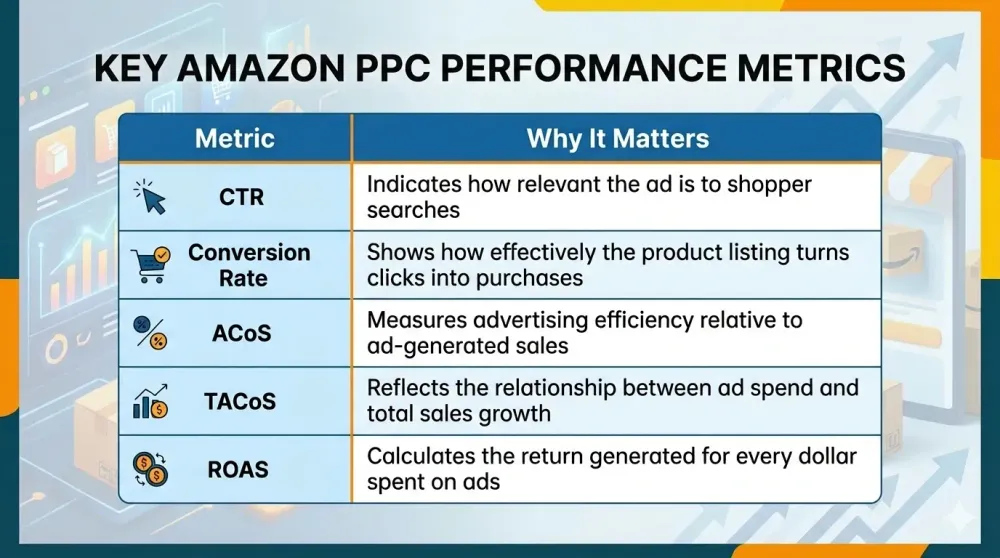
CTR (Click-Through Rate) helps determine whether the ad is attracting attention in search results. Higher CTR often signals that the product title, image, and targeting are aligned with shopper intent.
Conversion rate reflects listing performance. Even well-targeted Amazon PPC ads optimized for traffic will struggle if the product page does not convert.
ACoS and TACoS together provide deeper insight. While ACoS measures efficiency at the campaign level, TACoS reveals whether advertising is contributing to overall sales growth.
What Are the Most Common Amazon PPC Mistakes in 2026?
Most wasted ad spend on Amazon does not come from insufficient budgets. It usually results from poor campaign structure, weak monitoring, or an incomplete Amazon PPC ad strategy. When campaigns are not segmented properly, or performance signals are ignored, Amazon PPC ads may generate clicks without producing profitable sales.
Several mistakes continue to affect advertisers in 2026:
Running broad campaigns without negative keywords: Broad targeting helps discover new search terms, but without negative keywords, it can attract irrelevant traffic. This often causes Amazon PPC ads optimized for conversions to spend budget on low-intent searches.
Ignoring product listing quality: Even well-targeted ads struggle when the product page is weak. Poor images, unclear titles, or limited reviews can reduce conversion rates from every Amazon PPC ad click.
Relying only on ACoS: Many advertisers judge campaign success solely through ACoS. However, profitable Amazon PPC ads should also contribute to organic sales growth and stronger category ranking.
Overlapping campaigns targeting the same queries: Duplicate targeting across campaigns can cause internal bidding competition. This increases CPC and weakens overall campaign efficiency.
Underutilizing Sponsored Brands and Display: Some advertisers rely only on Sponsored Products and ignore upper-funnel formats. Using multiple Amazon PPC ads formats can help brands capture traffic at different stages of the shopping journey.
Advertising plays an important role when launching new products on Amazon. Research indicates that products supported by Amazon ads during launch can achieve up to 50% higher sales velocity compared with listings that rely only on organic traffic, helping them gain visibility and traction faster in competitive categories.
How Xneeti Helps Brands Run Amazon PPC Ads at Scale
Managing Amazon PPC ads becomes significantly more complex as brands expand their product catalogues and advertising budgets. Multiple campaigns, dozens of keywords, and changing performance signals can quickly make manual optimisation difficult. For growing brands, maintaining a consistent Amazon PPC ad strategy often requires stronger data visibility, structured campaign architecture, and automated optimisation tools.
Xneeti addresses this challenge by helping brands coordinate advertising strategy, campaign structure, and performance insights within a unified system designed for Amazon growth.
1. AI-assisted campaign architecture
Structured campaigns are easier to optimise and scale, but maintaining them across many products can be time-consuming. Xneeti helps advertisers organise Amazon PPC ads optimized for discovery, scaling, and brand protection so that performance signals remain clear and actionable.
2. Unified creative and media optimisation
Advertising performance is closely linked to listing quality. By aligning campaign data with product content insights, Xneeti helps ensure every Amazon PPC ad supports well-optimised listings that improve conversion potential.
3. Multi-ASIN performance control
Brands managing large catalogues often struggle to track how individual products perform across campaigns. Xneeti provides clearer visibility across multiple ASINs, making it easier to monitor Amazon PPC ads performance and adjust strategy as the catalogue grows.
Rethink How You Manage Amazon Advertising
For product brands, Amazon PPC ads remain one of the most effective ways to capture high-intent shoppers and accelerate marketplace growth. When campaigns are structured well and continuously optimised, advertising can strengthen both paid visibility and organic ranking.
As campaigns grow more complex, managing performance across multiple products requires better structure and data clarity. Xneeti OneOS helps brands organise and scale Amazon PPC ads optimized for long-term growth. Book a demo with Xneeti to see how a smarter campaign system can improve your Amazon advertising performance.


