

Your ACoS is rising, ad spend keeps increasing, and yet the Amazon ppc management cost behind it all still feels unclear. Most sellers hear numbers, agency percentages, flat retainers, and tool subscriptions, but rarely get a clear view of what they are actually paying for.
According to eMarketer, US advertisers are projected to spend $69.33 billion on retail media in 2026, with Amazon capturing the overwhelming majority of that growth. Choosing the wrong PPC management model at the wrong stage does not just impact costs, it slows growth and compounds inefficiencies.
In 2026, agencies typically charge 10–25% of ad spend or $2,000–$15,000/month, while in-house teams can exceed $250,000 annually. Platforms like Xneeti are helping brands rethink how these costs are structured, but making the right decision still depends on understanding what each model truly costs at your scale. This guide breaks down the real amazon ppc management cost across agency, in-house, and AI-led models, including what is included, what is not, and how those costs shift as your ad spend scales.
What Is the Cost of Amazon PPC Management?
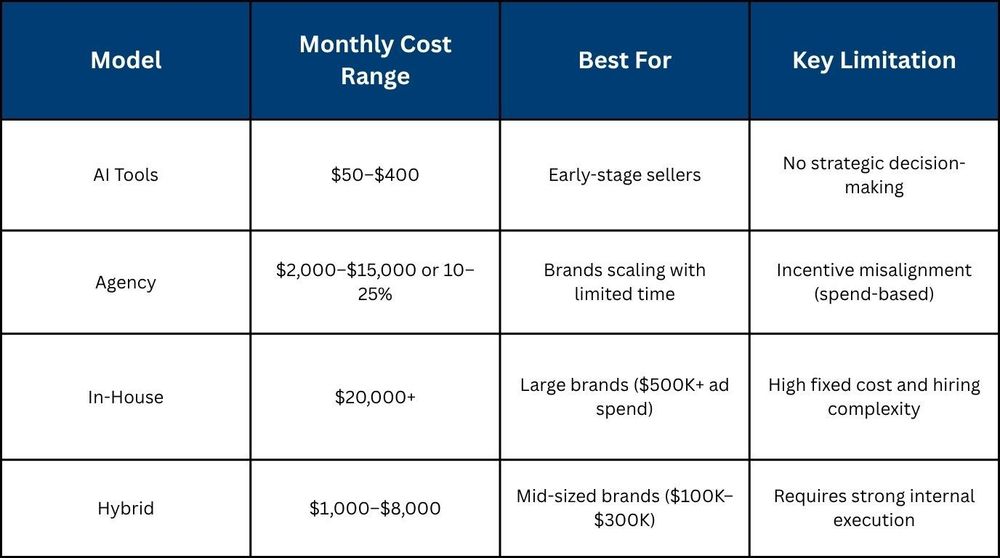
Amazon PPC management cost in 2026 typically ranges across four models:
- $50–$400/month: AI automation tools (often listed among the top Amazon ads software tools used by early-stage sellers)
- $2,000–$15,000/month: Agencies (or 10–25% of ad spend)
- $20,000+/month: In-house teams (fully loaded cost)
- $1,000–$8,000/month: Hybrid models (strategy + internal execution)
The right model depends on your ad spend, internal bandwidth, and how much strategic control you need.
Amazon PPC Management Cost Comparison (2026)
What Are the Three Core Models and Which Philosophy Is Behind Each?
Before comparing numbers, you need to understand what each model is built around. The cost difference between models isn't arbitrary - it reflects a different philosophy about who runs your campaigns, how fast decisions get made, and what you're paying for as your brand scales.
Traditional Agency Management
Traditional agency management means outsourcing campaign execution entirely. A team outside your company handles strategy, bid management, keyword research, and reporting under a recurring fee structure.
This model is built for brands that want a managed relationship rather than internal capability. It's most common among sellers running $30K–$500K/month in ad spend who don't have the bandwidth or expertise to run campaigns themselves.
The fee structure determines everything here. Whether the agency charges a percentage of spend or a flat retainer changes what they're incentivised to do with your budget. A percentage model rewards higher spend. A flat model rewards efficiency. Both can work - but the incentive structure shapes every decision the team makes on your account, every single month.
In-House Team
Building in-house means hiring PPC specialists directly onto your payroll. Full control, full accountability, full cost.
This model makes sense at significant scale - typically $500K+ per month in ad spend - where the volume justifies building and maintaining a full internal function. Below that threshold, the all-in cost of recruiting, salary, tools, benefits, and turnover almost always exceeds what structured external management would cost.
The common mistake is counting only the specialist's salary. Once you add recruiting fees, tool subscriptions, ramp time, and the cost of replacing someone who leaves, the annual figure typically lands above $250,000. In-house gives you control, but the overhead is higher than most brands expect before they run the actual numbers.
AI-Native Platform
An AI-native platform is neither a tool nor a traditional agency. It's a purpose-built system where natively engineered AI handles continuous execution - bid adjustments, keyword analysis, budget pacing, listing alignment - while dedicated account strategists own direction and account health.
This model is built for brands that need the strategic depth of expert management without the overhead of a full internal team or the structural limitations of traditional management cycles. What you pay for is a system that runs continuously, not a team that checks in periodically.
The cost is structured around output and efficiency, not billable hours or percentage of spend. AMC attribution, content generation, and inventory intelligence are built in - not billed as add-ons.
What Are You Actually Paying For With Amazon PPC Agency Fees?
Agency fees are not simply a charge for running your campaigns. The structure of the fee itself determines what the management team is incentivised to do - and that has a direct impact on how your budget is handled month over month. Understanding Amazon PPC agency fees starts there, not with the percentage.
Percentage of Ad Spend (10–25%)
You pay a percentage of your total monthly ad spend, typically between 10% and 25%. This is the most widely used pricing model in the market.
The structural problem is straightforward: the management team earns more when you spend more, regardless of whether that spend is producing efficient returns. A brand running $100,000 per month pays $10,000–$25,000 in management fees alone. As the budget scales, the fee scales with it - with no automatic accountability tied to actual performance improvement.
This doesn't make the model illegitimate, but it makes scrutiny necessary. The right question isn't what percentage you're paying - it's what specific optimizations are being done each month to justify the fee at your spend level.
Flat Monthly Retainer ($2,000–$15,000)
A fixed monthly fee that stays the same regardless of how your ad budget moves. The management team earns the same whether your spend goes up or down.
This structure removes the spend-inflation incentive entirely, which is why it's growing in adoption in 2026. The range is wide, though. What's included at $2,000/month looks very different from a $15,000 retainer. The fee tier typically reflects account complexity, catalog size, and depth of service - so the number alone tells you very little without a detailed scope of work.
Hybrid Structure (Base Fee + % Over a Threshold)
A fixed monthly base combined with a smaller percentage that applies only when spending crosses a defined threshold.
This works well for brands at $100K–$300K/month in ad spend. It gives cost predictability at lower spend levels with a variable layer that activates at higher volumes. The threshold amount and the percentage rate need to be documented clearly before the engagement begins. Ambiguity here tends to resolve in the management team's favor.
What Is Usually Included and What Is Not?
A fee that looks competitive at the headline level can expand considerably once excluded services are priced in separately.
Red Flags Worth Catching Before You Sign
- Percentage fees above 25% with no clear explanation of what additional value justifies the rate.
- Performance KPIs that are defined and measured by the management team - targets set this way tend to be achievable regardless of your actual business growth.
- No direct access to your own Campaign Manager or unfiltered performance data.
- Vague or punishing exit terms - long notice periods or high early termination fees are worth flagging before the contract is signed.
- Non-refundable setup fees with no deliverables tied to them.
Holding an Amazon Ads Verified Partner status is a credibility baseline worth checking, but it's an entry threshold - not a measure of how well your account will actually be managed.
What Does AI Automation Actually Get You at $50–$400/Month?
Automation tools are the lowest-cost entry point into managed PPC - and they're built for exactly that role. At this price point, you're paying for mechanical execution, not strategy. The gap between what a tool can do and what active management delivers is not a flaw in the tool. It's a design decision. Understanding that gap is what tells you whether you've outgrown this tier.
What AI Tools Handle Well
Automation tools perform the repetitive, rules-based layer of campaign management reliably:
- Bid adjustments based on predefined rules and performance thresholds
- Basic keyword harvesting from search term reports
- Budget pacing across campaigns
- Dayparting (adjusting bids by time of day or day of week)
- Performance alerts and automated reporting dashboards
- Rule-based negative keyword additions
For brands under $30K/month in ad spend, this is often enough. The mechanical work gets done, the account stays active, and the cost stays proportionate to the scale of the business.
What AI Tools Cannot Do
The gaps become material as spend grows:
- Build or restructure campaign architecture from scratch
- Identify the n-gram patterns inside search terms that are quietly bleeding spend
- Develop a TACoS reduction strategy tied to your actual margins
- Run and interpret Amazon Marketing Cloud attribution - halo effects, new-to-brand rates, full path to purchase
- Align ad strategy with listing quality, inventory levels, or pricing changes
- Optimize for Rufus and the A10 algorithm simultaneously
- Make strategic calls during peak windows like Prime Day or Q4
Why Sellers at $100K+ Outgrow Tools Quickly
At lower spend levels, automation handles enough of the workload to produce acceptable results. As spending grows, the gaps compound. A tool cannot tell you why your ACoS is rising relative to revenue. It cannot catch a competitor keyword eating your impression share. It cannot decide whether to pull budget from one ASIN to protect margin on another.
The difference between an automation tool and an AI-native platform is not execution speed - it's the layer of strategic judgment that runs underneath the automation. That layer is what tools at this price point are not built to provide.
Is the Hybrid Model a Smart Middle Ground or a Costly Compromise?
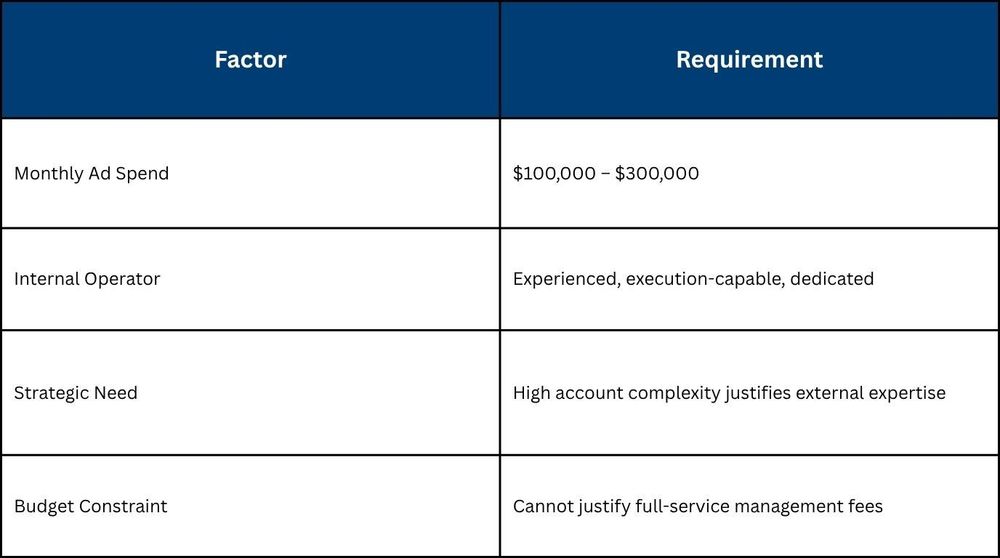
The hybrid model works, but only when your internal operator is genuinely capable of executing on strategy, not just attending calls and forwarding reports. When that capability exists, it is one of the most cost-efficient structures available. When it does not, you end up paying for two models and getting half the benefit of each.
What It Looks Like
An external team handles strategy, campaign architecture, and high-level direction. Your internal operator executes, implementing changes, monitoring daily performance, and flagging anomalies. The fee for the strategic layer typically runs $1,000–$3,500 per month, significantly lower than full-service Amazon PPC management pricing.
Who It Is Best For
What Makes It Fail
- The internal operator is stretched across multiple responsibilities and cannot execute directives consistently.
- The strategic partner is not deeply embedded in the account, direction is given monthly, not continuously.
- No clear ownership boundary between internal and external, decisions stall in the gap between the two.
- The brand outgrows the model but does not reassess, what works at $150K/month becomes insufficient at $300K+.
Which Model Actually Fits Your Spend Level?
The right model is not about preference, it follows your spend level and how much execution capacity you genuinely have internally.
Under $30K/Month
- Recommended Model: AI automation tools or entry-level flat-fee management.
- Approx. Monthly Cost: $50 – $500
- When to Reassess: When campaigns outgrow rule-based automation and strategic gaps start showing in your ACoS.
$30K – $100K/Month
- Recommended Model: Flat-fee external management.
- Approx. Monthly Cost: $2,000 – $5,000
- When to Reassess: When account complexity, catalog size, keyword architecture, and creative needs exceed what a single flat-fee scope covers.
$100K – $300K/Month
- Recommended Model: Hybrid or full-service flat-fee management.
- Approx. Monthly Cost: $1,000 – $8,000
- When to Reassess: When your internal operator is consistently behind on execution, or the strategic layer is not embedded deeply enough in your account.
$300K – $500K/Month
- Recommended Model: Full-service management or AI-native platform.
- Approx. Monthly Cost: $8,000 – $15,000
- When to Reassess: When the pace of auction changes, inventory shifts, and competitive movement exceed what periodic management reviews can respond to.
$500K+/Month
- Recommended Model: AI-native platform or dedicated in-house team.
- Approx. Monthly Cost: $15,000 – $25,000+
- When to Reassess: When you need hourly responsiveness, full attribution visibility, and operational integration that no traditional model is structurally built to deliver.
How Does Xneeti's AI Platform Redefine Amazon PPC Management Cost?
Xneeti is not structured like any of the models covered above, it is a multi-marketplace AI platform where natively built AI and dedicated account strategists operate as a single, continuous system. Unlike traditional models, where strategy is reviewed periodically, and execution follows days later, Xneeti's AI runs continuously across every layer of your account, closing the gap between insight and action. For brands evaluating Amazon PPC management pricing, Xneeti represents a fundamentally different structure, one where what other models charge extra for, or do not offer at all, is built into the platform by default.
1. Continuous AI Execution, Not Periodic Reviews
Xneeti's natively built AI adjusts bids by hour, day, and placement level based on your account's actual conversion patterns, while simultaneously tracking competitor keywords and eliminating spend-bleeding search terms before they surface in your ACoS report.
2. Built for How Amazon Works in 2026, Not Legacy Auction Logic
Xneeti optimizes listings and ad strategy for both the A10 algorithm and Rufus, ensuring your products are positioned for how Amazon surfaces and recommends them to shoppers today.
3. Everything Included, Nothing Billed Separately
AMC attribution, in-house video and image generation, inventory prediction, payout intelligence, and real-time Insight Intelligence are all built into the platform with no add-on fees and no production bottlenecks.
4. Results That Reflect the Difference
Xneeti manages 80+ accounts across categories, delivering an average 50% reduction in TACoS and 30% revenue growth, rated 4.8 on Google and 4.6 on Trustpilot by sellers running real Amazon businesses.
Still Running on a Model That Was Not Built for 2026?
Choosing the right Amazon PPC management model comes down to three things, your current spend level, your internal execution capacity, and how quickly your account needs to respond to a market that moves by the hour. Every model covered in this guide has a stage where it makes sense, and a point where it stops serving your growth. The cost of staying in the wrong one longer than necessary is rarely visible on an invoice, but it shows up in your numbers.
Xneeti is a multi-marketplace AI platform built for brands that need continuous execution, strategic depth, and complete operational visibility without the overhead, misaligned incentives, or capability gaps that come with traditional management models. With dedicated account strategists, natively built AI running across every layer of your account, and an average 50% reduction in TACoS across 80+ managed brands, the difference is measurable from the start. Book a demo today and see exactly what your account has been missing.


