

At some point, every growing Amazon seller hits the same wall. Bids need updating every few hours, search terms drain spend quietly across hundreds of keywords, and keeping performance consistent across a catalog of SKUs becomes a part-time job on its own. That is what makes Amazon automation not a nice-to-have, but the only practical way to scale without being buried in daily operations.
What most sellers do not realize is that automation is not one thing. It runs in layers: from Amazon's own native tools, to rules-based platforms, to full AI systems that run your operation the way a trained in-house team would. This guide covers all three layers for 2026, so you can match the right one to where your business actually is today.
Did You Know?
Amazon's advertising revenue crossed $68 billion in 2025, growing 22% year over year. The sellers holding top placements today are not always the ones with the biggest budgets. They are the ones acting on data faster than their competitors. Sellers managing PPC manually at $10,000 or more in monthly ad spend typically spend 20 to 30 hours per week on repetitive tasks alone, and that number does not drop on its own as the account grows.
Your step-by-step Amazon automation strategy
Before switching on any automation, you need a clear baseline and a defined direction. Automation run without this does one thing well: it scales whatever your account already is, including its problems. Get the setup right first, then let the system run.
Step 1: Audit your current campaigns before anything else
Go through every active campaign and answer three questions. Where is budget going? Which keywords are converting at a profitable rate? Where is spend running without returning sales?
Pull your search term report for the last 60 days and sort by spend descending. The keywords and search terms at the top of that list with zero or low conversions are your first priority. These are the terms that automation will keep spending on, because no rule knows they are waste unless you tell it first.
Check your campaign structure while you are here. Duplicate campaigns running on the same keywords, auto campaigns with no negative lists, and ad groups mixing high- and low-margin products are structural problems that automation amplifies rather than fixes. Clean the structure before any system takes over.
This audit also gives you your real starting metrics: actual ACoS by campaign, actual TACoS across the account, and where your impression share is sitting. You need these numbers before you can set meaningful targets in the next step.
Step 2: Set your KPI targets before touching any settings
Without hard numbers, automation has no direction. It optimizes toward the metrics it can see: clicks, conversions, ACoS on individual campaigns. The broader picture of whether the business is actually profitable stays out of frame.
Define three numbers before enabling anything.
Your TACoS target. This is total ad spend divided by total revenue, including organic sales. A TACoS of 10 to 12% signals a healthy ad-to-organic balance for most mature products. Launch-phase products will run higher, but set a ceiling for each product so automation knows when to pull back.
Your ACoS ceiling. Calculate your break-even ACoS from your product margin first. If your margin is 40%, break-even ACoS is 40%. Set your target ACoS 10 to 15 points below that to give the system room to operate while staying profitable.
Your ROAS floor. If you manage multiple SKUs, set a minimum ROAS by product category so automation does not push budget toward low-margin items just because they convert easily.
Write these down. They go into every rule, every bid target, and every budget cap you configure from here.
Step 3: Choose your automation layer based on where your account is today
Not every account needs the same level of automation. Getting this match wrong is where most sellers either overspend on tools they do not need or under-invest in ones that would actually move their numbers.
Early stage or under $5,000 in monthly ad spend: Start with Amazon's native tools. Auto-targeting campaigns, dynamic bidding set to down only, and basic budget rules in the Ads console are free and sufficient at this stage. Learn what these do and where they fall short before paying for anything external.
Stable mid-sized catalog at $5,000 to $30,000 monthly ad spend: Layer rules-based automation on top. The priority tasks here are keyword harvesting from auto campaigns to manual exact match, negative keyword addition on a defined click threshold, and bid adjustments within a capped range against your target ACoS. Platforms like Helium 10 Ads handle this well and keep the logic transparent.
Large or growing catalog at $30,000+ monthly ad spend: A connected AI platform covering ads, listings, inventory, and attribution is the right fit. At this scale, rules-based tools cover the mechanics but miss the contextual signals that determine real profitability: placement-level performance, hourly bid optimization, and halo attribution. This is where Xneeti operates.
Step 4: Start automation in the highest-impact area first
Start with keyword harvesting. This is the single automation that typically recovers the most time and improves account hygiene the fastest, because it replaces the weekly manual cycle of downloading search term reports, filtering for converters, and manually moving terms to manual campaigns.
A basic starting rule: if a search term in an auto campaign generates two or more orders with an ACoS below your target over the past 30 days, move it to an exact match keyword in your manual campaign at a calculated starting bid.
Run this for two to three weeks before adding the next layer. Check that the terms being promoted are genuinely relevant and that the bids are landing in a competitive range. Adjust the order threshold if the account's conversion rate warrants it.
Add negative keyword automation next. Set a threshold (typically 20 clicks with zero conversions or $30 in spend with no sales) and let the system flag or add these as negatives. Review the first batch manually before switching to full automation. The goal is catching spend bleed early, not excluding potentially profitable terms on too-thin data.
Step 5: Review weekly for the first 60 days, then adjust your targets
No automation setup holds its settings permanently. The first 60 days are where you find out whether your thresholds match your account's actual behavior.
Review TACoS trends weekly. If TACoS is rising while ACoS stays flat, organic sales are being displaced by paid, a common sign that bid targets are too aggressive. If TACoS is improving, the automation is creating real lift.
Check impression share on your top-converting keywords. If automation is reducing bids but you are losing placement on terms that drive revenue, the ACoS ceiling may be set too tight.
Look at what the system has been doing, not just the performance numbers. Most platforms have an action log showing every automated change. Review this in the first month to confirm the rules are executing as intended and the thresholds are calibrated to your actual margin structure.
After 60 to 90 days of stable performance, extend automation to broader campaign management, budget pacing, and portfolio-level decisions.
Why Does Manual Amazon PPC Management Stop Working at Scale?
Managing Amazon ads manually works until it does not. The moment your catalog grows, your SKU count increases, or your ad spend crosses a meaningful threshold, the volume of daily decisions starts outpacing what any person or team can realistically handle.
The auction does not wait for weekly reviews
Bids reprice every hour. Search term reports pile up across hundreds of keywords. Budgets hit caps during the highest-converting windows of the day, often mid-morning when shoppers are most active. By the time a manual review catches the issue and adjustments are made, the auction has moved on.
Amazon's advertising revenue surpassed $68 billion in 2025, growing 22% year over year. The sellers holding top placements are not always the ones with the biggest budgets. They are the ones acting on data faster than their competitors. Manual Amazon PPC management cannot match that speed past a certain scale.
Wasted spend accumulates before you can see it
The damage from manual PPC rarely shows up as one large problem. It arrives as bids running on last week's data while the auction moves in real time. Budgets hitting daily caps mid-morning with no one catching it until the window has passed. Negative keywords added after the wasted spend has already landed in the ACoS report, not before it.
Each individual loss is small. An account running 10% inefficiency at $20,000 per month in ad spend is leaving $24,000 a year on the table. That number does not shrink as ad spend grows.
Time cost compounds with catalog size
Managing five products manually might take 10 to 15 hours per week. Managing 20 products typically runs 20 to 30 hours, because each product needs dedicated keyword review, campaign monitoring, and bid adjustment. That time does not scale with a team the way headcount does. It scales with SKU count, keyword volume, and campaign count, all of which grow faster.
The compounding factor is context switching. Moving between Seller Central's advertising console, search term report downloads, spreadsheet analysis, and campaign implementation creates overhead that stretches every task. What should take 30 minutes takes two hours across a morning. Multiply that by five products becoming twenty, and manual management becomes the ceiling on growth.
What Can and Cannot Be Automated in Amazon Advertising?
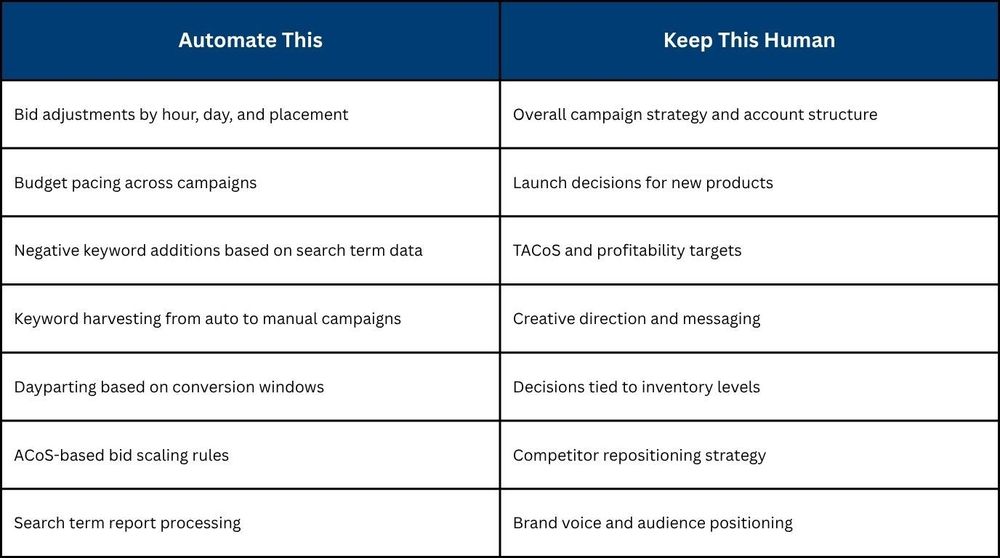
Amazon advertising automation works best on decisions that are repetitive, data-driven, and time-sensitive. Human judgment is still needed for decisions that require business context, brand strategy, or information that lives outside the ad account.
Here is a clear breakdown:
Why This Distinction Matters
Automation handles execution. It processes data at a speed and volume no human can match. But it only optimizes for the metrics and rules it is given. It cannot factor in that you are intentionally overspending on a launch to build rank, or that a stockout is coming in 10 days, and campaigns need to pull back.
The best-performing accounts using Amazon advertising rules and automation are the ones that are deliberate about this boundary. They give automation the grunt work and keep strategy in human hands.
How Does Amazon's Native Automation Actually Work?
Before looking at third-party tools or AI platforms, it helps to understand what Amazon already gives you inside the Ads console. Amazon's native automation covers three areas, and for sellers just starting out with automation, these are the natural first layer to work with.
Auto-Targeting Campaigns
Auto-targeting campaigns let Amazon match your ads to search terms based on your product listing and shopper behavior, without you having to select keywords manually. They are useful for discovering and converting search terms early on, but they optimize for traffic rather than profitability, which means spending can spread thin without regular review.
Dynamic Bidding and Budget Rules
Amazon's dynamic bidding options, down only, up and down, and fixed bids, adjust your base bid in real time based on the likelihood of a conversion. You can also set basic budget rules to increase spend on planned dates, but the control stays at a surface level with no placement-level or hourly bid logic available.
Where Native Automation Reaches Its Limit
Amazon's built-in Amazon advertising rules react to what has already happened in your account rather than predicting what is coming next. For a seller managing a growing catalog with active ad spend and profitability targets, native automation covers only a fraction of what needs to happen on a daily basis.
How Do Rules-Based Automation Tools Work?
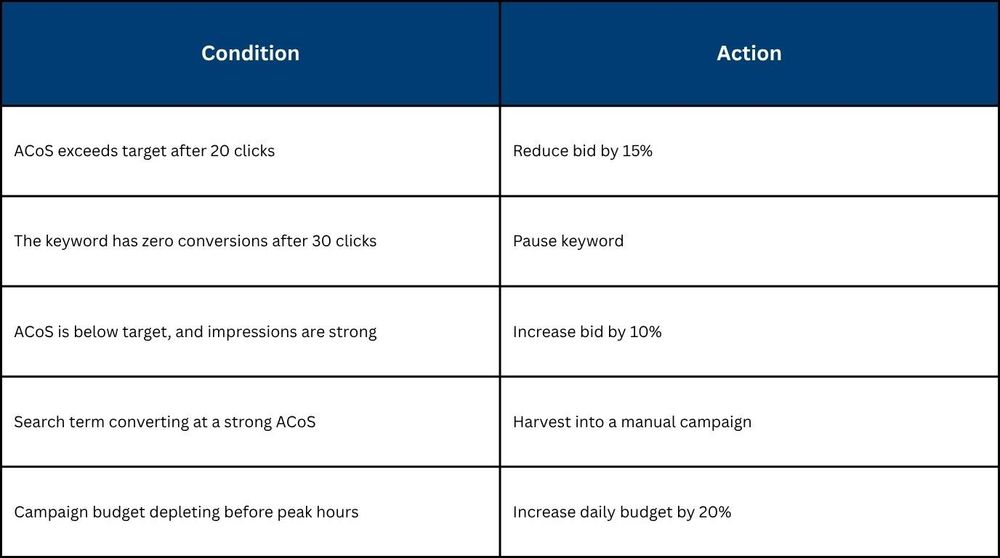
Rules-based Amazon PPC automation tools work by following a simple if-then logic. When a set condition is met in your campaign data, the tool automatically takes a predefined action, without you needing to intervene manually.
How the Logic Works
Every rule is built around a performance threshold you define upfront. When the data hits that threshold, the tool adjusts the bid, pauses the keyword, or shifts the budget on its own.
Here is what a basic rule set looks like in practice:
Where Rules-Based Tools Add Real Value
For accounts with consistent traffic and stable conversion patterns, Amazon bid automation tools handle the repetitive daily work well. Bid hygiene stays clean, budgets stay in check, and negative keywords get added on schedule rather than reactively.
Amazon Ads reported that AI-powered automation now results in 67% faster campaign launches and significantly reduced daily management time, which shows just how much structured automation can reclaim for growing teams.
What Does AI-Powered Amazon Ad Automation Actually Change?
Unlike rules-based tools that act on conditions you predefine, AI Amazon PPC management continuously learns from your account's own data and makes decisions in real time without waiting for a threshold to be triggered manually.
1. It Works on Your Data, Not Category Averages
AI analyzes your account's conversion patterns by placement, hour, and keyword, and adjusts bids based on what is actually working in your specific account rather than general industry benchmarks.
2. It Catches Problems Before They Show Up in Reports
Through n-gram analysis, AI identifies wasteful search term patterns early and adds negatives systematically, before the spend damage appears in your ACoS report.
3. It Connects Data Across Your Entire Account
Rules work within a single campaign. Amazon advertising automation, powered by AI, looks across all campaigns simultaneously, connecting bid performance, budget pacing, placement data, and competitor keyword movements at the same time.
What does a complete AI-run Amazon ads operation look like?
Full-stack AI Amazon PPC management means every part of your Amazon operation runs under one connected AI system that works continuously, not just when someone logs in to check on it. Ads, listings, inventory, payouts, and attribution, all of it connected.
This is what that looks like when built properly, which is exactly how Xneeti operates as a natively built AI platform with dedicated account strategists managing every account.
Ads Engine: Bids, Placements, and Competitor Keywords
Bids are adjusted by hour, day, and placement type, such as top of search, rest of search, and product pages, based on your account's own conversion data. Competitor keywords driving their impression share are tracked and folded into your campaigns, and n-gram analysis catches bleeding search term patterns before they show up in your numbers.
Listings and SEO: Optimized for How Amazon Works Today
Listings are optimized for both Amazon's A10 algorithm and Rufus, Amazon's AI shopping assistant that now influences what shoppers find before they even run a search. Over 250 million customers used Rufus in 2025, and shoppers who engage with it are 60% more likely to complete a purchase. Listings that are not optimized for this layer are already losing visibility.
Inventory Intelligence: Reorder Before the Danger Window
The system watches sales velocity, ad spend rate, and supplier lead time together, and flags a reorder recommendation before stock levels become a problem. Not after a stockout has already pulled your rank down.
Payout Intelligence: Every Fee Reconciled in Plain English
Understanding your true cost per sale, such as fees, reserves, reimbursements, and deductions, is reconciled automatically and reported in plain language. You know exactly what landed, why, and what is coming next cycle, without digging through Seller Central reports manually.
AMC Attribution: The Signals Campaign Manager Does Not Show You
Through Amazon Marketing Cloud, the platform surfaces halo effects, new-to-brand rates, and the full path to purchase that standard Campaign Manager reporting keeps hidden. This is where Amazon DSP automation connects paid performance to actual customer acquisition data.
Insight Intelligence: Ask Your Account Anything
Instead of waiting for a weekly report or raising a support ticket, you can ask your account a direct question and get a plain-English answer in seconds. This is what it means to automate Amazon ads at the intelligence level, not just the execution level.
The right service means nothing without the right strategy behind it. Later in this guide, we walk through exactly how to build your Amazon automation approach step by step, based on where your business is today.
Best tools to automate Amazon ads
The right automation tool depends on what your account needs and where you are in your growth. Here are the three platforms worth considering in 2026.
Xneeti
Xneeti is a natively built AI platform engineered from the ground up for how Amazon operates today, not a third-party tool assembled from off-the-shelf software. Every capability, from the ads engine to inventory intelligence to payout reconciliation, was built in-house by a team that includes founders who managed Amazon categories from the inside and engineers who built ad systems at Google, processing billions of signals daily.
Accounts on Xneeti see an average 50% reduction in TACoS and 30% revenue growth, with each account managed by a dedicated strategist at an account-to-manager ratio 50% lower than the industry standard.
Key features:
- Hourly bid adjustments by placement type based on your account's own conversion data
- AI-driven listing optimization for both Amazon's A10 algorithm and Rufus
- Inventory reorder recommendations before stock levels become a risk
- Full AMC attribution, including halo effects, new-to-brand rates, and path to purchase
- In-house Sponsored Brands Video module that removes the production bottleneck stopping most sellers from running video at scale
Best for: Mid-to-large sellers wanting one connected AI system across their entire Amazon operation.
Perpetua
Perpetua offers goal-based bid automation where you set a target and the platform optimizes campaigns toward it automatically. It covers Sponsored Products, Sponsored Brands, and DSP management within a clean, accessible interface. The setup is simpler than most enterprise tools, which makes it a reasonable fit for sellers who want AI-assisted bidding without configuring rules from scratch.
Best for: Sellers wanting simplified AI bidding without complex manual configuration.
Pacvue
Pacvue is built for enterprise-level Amazon advertising with deep analytics, dayparting controls, and advanced campaign management across multiple markets. It is widely used by large brands and agency teams handling significant ad spend. The platform offers strong reporting depth and cross-marketplace coverage, though it requires more setup time and budget than mid-market tools.
Best for: Large brands and agencies managing significant budgets across multiple Amazon marketplaces.
What Automation Mistakes Are Quietly Killing Your Amazon Ad Performance?
Most Amazon PPC automation setups do not fail because of the technology, they fail because of what happens before and after it is switched on. These four mistakes are the most common reasons automated accounts underperform.
- Automating a messy account: Automation scales what already exists, so unresolved structural issues get bigger, not fixed.
- Acting on too little data: Rules triggered on five or ten clicks are making decisions based on noise, not real performance patterns.
- Watching ACoS and ignoring TACoS: A healthy ACoS can mask rising Amazon advertising automation costs eating into total revenue without anyone noticing.
- Never reviewing what the system does: Automation handles execution, but still needs weekly human oversight to stay aligned with your actual business goals.
Is Xneeti the Future of Amazon Advertising Automation for Serious Sellers?
Xneeti is not just another option in a crowded space of Amazon advertising automation platforms, it is a fundamentally different operating model built by people who designed Amazon's own seller programs and engineered ad systems at Google. For sellers who have outgrown basic tools and want their entire Amazon operation run by AI with human intelligence layered on top, Xneeti is the best Amazon PPC software 2026, built specifically for this level of scale. Rated 4.8 on Google and 4.6 on Trustpilot by sellers managing real Amazon businesses, and backed by institutional investors B Capital and Good Capital, Xneeti's credibility is built on results, not promises.
- Multi-marketplace coverage across Amazon and Walmart: Xneeti's AI runs across both Amazon and Walmart, making it one of the few natively built platforms that manages paid performance on multiple marketplaces under one connected system.
- In-house Sponsored Brands Video module: Rather than outsourcing video production or skipping it altogether, Xneeti generates Sponsored Brands Video creatives through its own video module, removing the production bottleneck that prevents most sellers from running video ads at scale.
- Proven results with enterprise and high-profile brands: Xneeti manages Shark Tank brands and large enterprise sellers, with an account-to-manager ratio 50% lower than the industry standard, meaning every account gets the attention it actually needs to grow.
Ready to Stop Managing and Start Scaling?
The automation landscape for Amazon sellers has matured significantly, and the gap between sellers running native rules and those operating on a fully connected AI system is only getting wider. Understanding where Amazon advertising automation begins, where it plateaus, and what genuine AI-native management looks like is what separates accounts that scale from accounts that stall.
For sellers who are ready to move beyond patching together tools and want one system that runs their entire Amazon operation with real intelligence behind every decision, Xneeti is the best Amazon PPC software 2026 has to offer for brands serious about growth. Book a demo today and see what your account looks like when AI and human expertise work together.


