

Most Amazon sellers are running ads. But most are only using one format out of eight. Sponsored Products gets all the budget, while the other seven types of Amazon ads go completely ignored. Those ignored formats are exactly where smarter brands are growing faster, reaching more shoppers, and building something that lasts. Missing them is not a small oversight. In a competitive marketplace, it is a real cost.
Did You Know? Amazon's advertising revenue surpassed $68 billion in 2025, making it the third-largest digital ad platform in the world behind only Google and Meta.
Amazon now offers eight different Amazon advertising types across search, display, streaming, and programmatic channels. Each one serves a different purpose in how shoppers find and buy products. Brands that understand all eight build strategies that grow over time. Brands that don't keep spending more on one format and getting less back. Platforms like Xneeti help sellers run all of them together through one AI-powered system. In this blog, we break down every format clearly so you know exactly what to run and when.
How Many Different Types of Amazon Ads Exist in 2026?
There are 8 Amazon ad types available in 2026, spread across three buying channels: self-serve, DSP, and managed. That is the short answer. Here is the map before we get into the details.
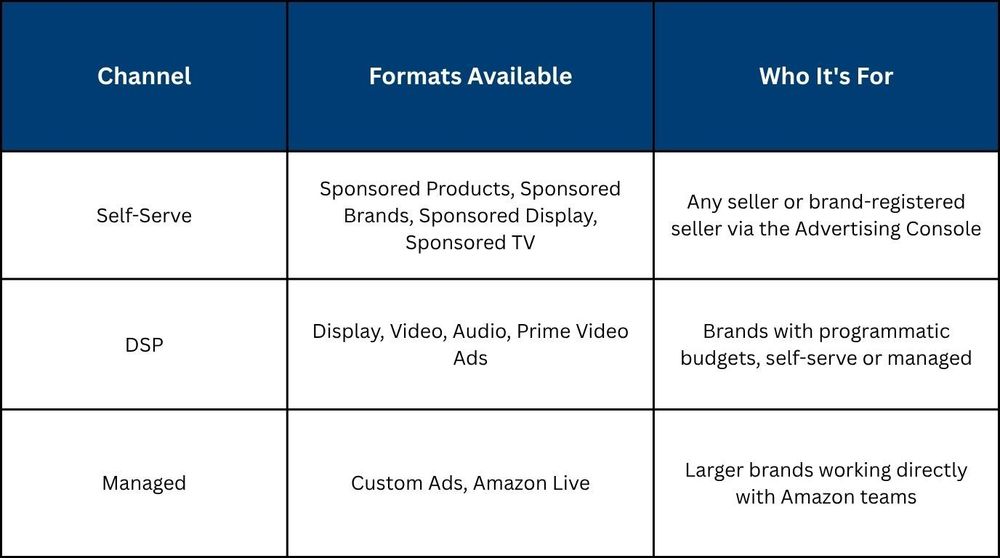
Each channel serves a different purpose. Self-serve is where most sellers start and where most of the day-to-day performance advertising happens. DSP is where brands go when they want to reach shoppers beyond the search results page. Managed is for custom, high-investment campaigns built in collaboration with Amazon directly.
According to Amazon Ads, Amazon reaches an average of more than 300 million monthly ad-supported customers across its owned and operated properties in the US alone.
The 3 Amazon Advertising Channels: Self-Serve, DSP, and Managed
Before diving into individual formats, it helps to understand how Amazon's advertising system is structured. There are three channels through which all Amazon ad campaign types are accessed, and knowing which one applies to you determines what you can run today.
1. Self-Serve
This is where most sellers start. You log in to Amazon's Advertising Console, create a campaign, and launch, with no minimum spend, no approval process, and no account manager required. Sponsored Products, Sponsored Brands, Sponsored Display, and Sponsored TV all live here.
2. Amazon DSP
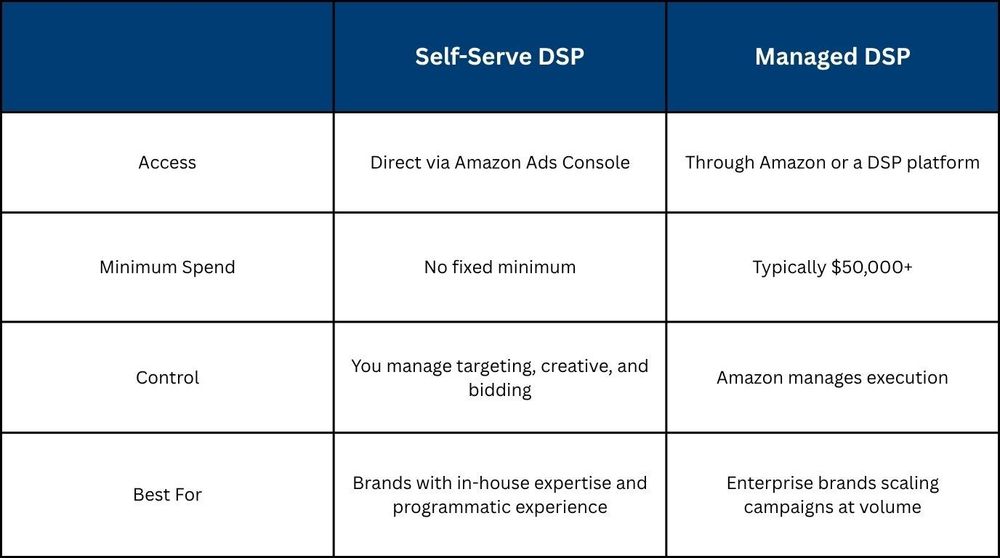
Amazon DSP lets brands buy display, video, and audio placements across Amazon's properties and thousands of third-party websites using Amazon's first-party shopping data. It comes in two forms: self-serve with no fixed minimum spend, and managed service, which has historically required $50,000+, meaning it is far more accessible than most sellers assume.
3. Managed Service
This channel is for larger brands working directly with Amazon's internal teams on custom, high-investment campaigns that go beyond what the standard console offers. It involves bespoke creative formats, tailored audience strategies, and dedicated Amazon account support.
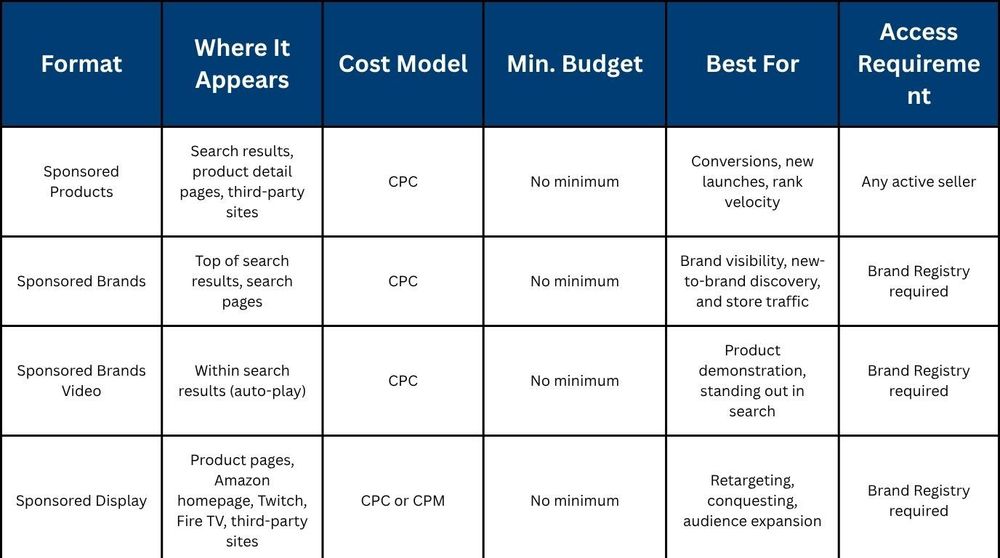
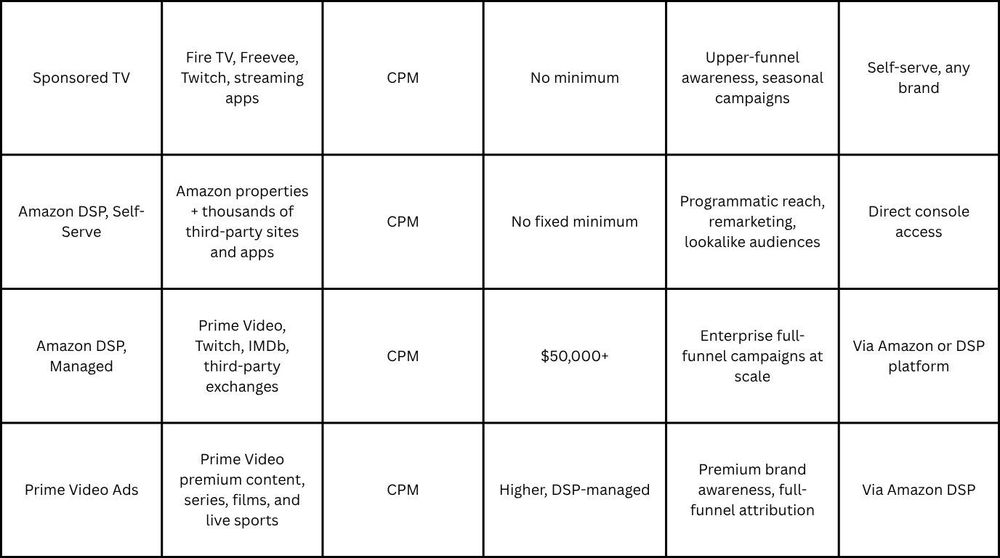
All Amazon Ad Types at a Glance
Before deciding which format to run, here is how every Amazon ad type stacks up side by side.
Sponsored Products: The Default Starting Point for Amazon Advertisers
Sponsored Products are cost-per-click ads that promote individual product listings directly within Amazon's search results and product detail pages. They are available to every active seller, no brand registration needed, no minimum spend, and no approval process. Among all the types of Amazon ads, this is the one most sellers know. It is also the one most sellers stop at.
Where Do Sponsored Products Appear?
1. Top of search results, the highest-visibility placement on the page.
2. Within organic search results, rows 2 through 5 and beyond.
3. On competitor and related product detail pages.
4. Across category browse and carousel placements.
5. On select third-party apps and websites outside Amazon.
What Targeting Options Are Available?
Automatic targeting: Amazon scans your listing and matches it to relevant search queries, no manual input needed to get started.
Manual keyword targeting: You choose your own keywords and set match types, broad, phrase, or exact, based on what your data shows.
ASIN and category targeting: Your ad shows up directly on competitor or related product pages, putting your listing right next to the competition.
Audience targeting: Rolled out in 2025, this targets shoppers by in-market behavior and past purchase signals, not just what they searched.
What Does It Cost?
Sponsored Products run on a CPC model, you pay only when someone clicks. Cost-per-click generally falls between $0.50 and $2.50, but categories like supplements, electronics, and beauty tend to push that higher. You control your bids and daily budget, so there are no surprise charges.
What Is It Best For?
New product launches, high-intent buyers, and organic rank improvement. Every sale driven through Sponsored Products feeds into your product's ranking signal on Amazon, so the format works on two levels at once.
Advertisers who used Sponsored Products saw an average of 34% more sales growth compared to those who didn't, measured four weeks after adoption.
2026 Update: Rufus and What It Means for Your Ads
Amazon's AI shopping assistant Rufus now surfaces Sponsored Products inside conversational search responses. When a shopper asks Rufus a question like "what's a good protein powder for runners," sponsored results can now appear within that answer, not just in the standard search grid.
Sponsored Brands: Banner Ads, Store Spotlights, and Video
While Sponsored Products put a single product in front of a shopper, Sponsored Brands put your entire brand there. These are banner-style ads that appear at the very top of search results, above everything else, showing your logo, a custom headline, and multiple products together in one placement. Among all Amazon ad formats, Sponsored Brands is the one that turns search real estate into brand real estate.
Access requires Amazon Brand Registry enrollment. If you are not yet brand-registered, this is one of the strongest reasons to become so.
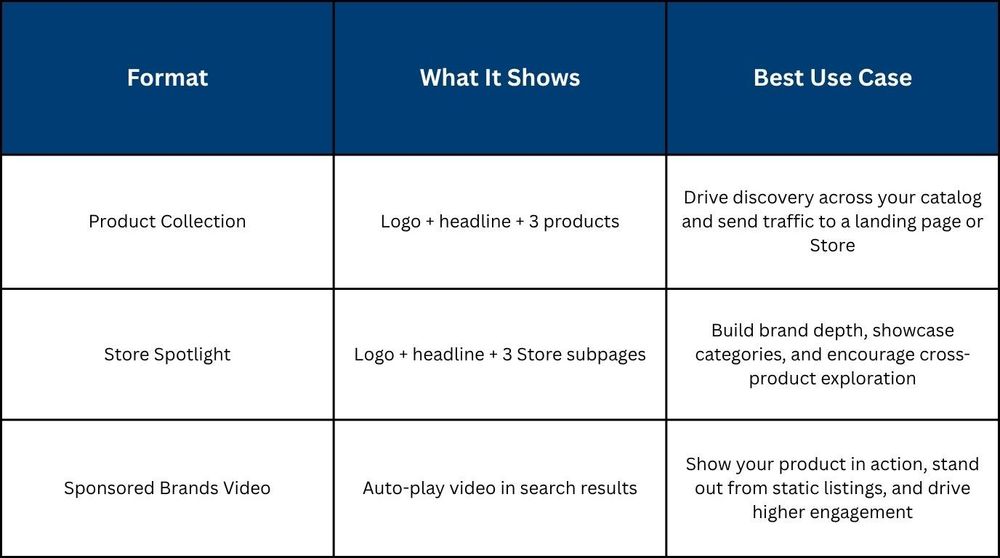
Which Creative Format Should You Use?
What Is It Best For?
Sponsored Brands work hardest when you want to own the top of a search page, introduce your brand to first-time category browsers, and drive traffic to your Amazon Store rather than a single product. It is the go-to format for new-to-brand customer acquisition.
Myth-Bust: Sponsored Brands Video Is Not a DSP Product
This is one of the most common misconceptions across all Amazon ad formats. Many sellers assume running video on Amazon requires a DSP account or a large budget. It does not. Sponsored Brands Video is fully self-serve, CPC-based, and has no minimum spend. If you have a product video and Brand Registry, you can launch today.
Sponsored Display: Remarketing, Audience Targeting, and Off-Amazon Reach
Most sellers think Sponsored Display is a retargeting tool. It was, but it is not anymore. Among the Amazon advertising types that have changed the most in recent years, Sponsored Display has evolved the furthest. It now reaches shoppers across the full funnel, from people who have never heard of your brand to those who visited your listing and left without buying.
What Targeting Options Does It Offer?
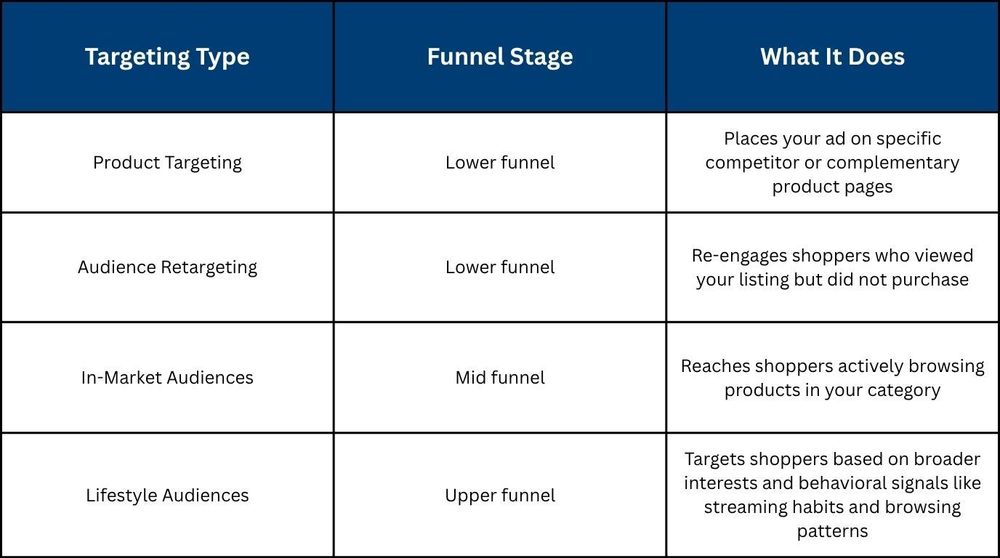
Where Does It Appear?
Sponsored Display does not stay on Amazon. Ads appear on product detail pages, Amazon's homepage, Twitch, Fire TV, and across third-party websites and apps outside Amazon entirely. This off-Amazon reach is what makes it genuinely different from Sponsored Products and Sponsored Brands, your brand stays visible even after a shopper leaves the store.
What Does It Cost?
The cost model depends on what you are optimizing for. Product targeting and retargeting campaigns typically run on CPC. Awareness-focused campaigns using lifestyle and in-market audiences run on CPM. Both options are available within the same self-serve interface.
Amazon's Sponsored Display audience targeting now reaches shoppers across four distinct segments, in-market, lifestyle, interests, and life events, all powered by Amazon's first-party shopping and streaming signals from Amazon, IMDb, Prime Video, and Twitch.
Amazon DSP: Full-Funnel Programmatic Advertising at Scale
Amazon DSP is a programmatic advertising system that lets brands buy display, video, and streaming TV placements across Amazon's own properties and thousands of third-party websites and apps, all powered by Amazon's first-party shopping, browsing, and streaming data. It is one of the most powerful Amazon campaign types available, and also one of the most misunderstood.
Self-Serve vs. Managed DSP — What Is the Difference?
What Can You Target With DSP?
DSP targeting goes well beyond what the Advertising Console can access. This is what makes it worth the learning curve:
- In-market audiences: Shoppers currently browsing and comparing products in your category, caught at the right moment.
- Contextual targeting: Your ad appears on third-party websites and content that naturally aligns with what you sell.
- Lookalike audiences: Reach new shoppers whose browsing and buying patterns mirror your existing customers.
- Remarketing: Bring back shoppers who visited your listing or left items in their cart, across the web, not just on Amazon.
- Life-stage targeting: Connect with shoppers going through major life changes, a new home, a new baby, a new school year, when buying intent is naturally high.
What About Amazon Marketing Cloud?
Amazon Marketing Cloud (AMC) is where DSP becomes truly powerful for multi-format advertisers. It lets you connect upper-funnel DSP impressions to lower-funnel Sponsored Products conversions, so you can see, for the first time, how a streaming TV ad on Tuesday influenced a search purchase on Friday. For brands running more than one of these Amazon ad campaign types, AMC is what turns fragmented data into a clear picture of how your full strategy is actually working.
Amazon DSP leverages trillions of browsing, shopping, and streaming signals to help brands reach nearly 90% of the US population with authenticated, internet-scale reach.
Prime Video Ads and Sponsored TV: Amazon's Upper-Funnel Formats in 2026
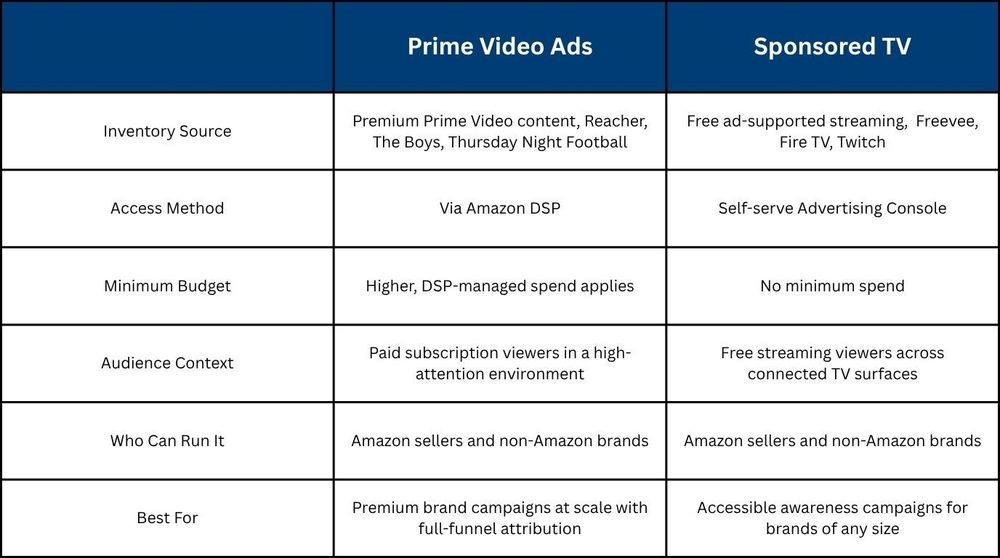
These are two separate formats. Most sellers treat them as the same thing, they are not. Both are video-based, both run on CPM, and both serve upper-funnel awareness goals. But they operate on entirely different systems, reach different audiences, and require different levels of access. Understanding the distinction is one of the things that separates a strategic advertiser from one guessing their way through the different types of Amazon ads.
Prime Video Ads vs. Sponsored TV: How Do They Actually Compare?
The Insight Most Sellers Miss
Sponsored TV became fully self-serve in 2024 with no minimum spend requirement. A brand spending $500 a month on advertising can now run a non-skippable, full-screen video ad on Fire TV. That access point did not exist two years ago, and the majority of sellers still do not know it is available to them today.
How Are They Priced?
Both formats run on a CPM model, you pay per thousand impressions, not per click. This means direct ACoS comparisons to Sponsored Products will always look unfavorable. The right metrics here are reach, new-to-brand customer acquisition, and brand recall over time, not immediate conversion. Amazon Marketing Cloud is what connects these upper-funnel impressions to downstream purchase behavior so you can actually measure the return.
Prime Video has an average monthly ad-supported reach of more than 130 million viewers in the US, and 88% of Prime Video households have shopped on Amazon.
Amazon's Full-Funnel Campaigns Tool: What Changed at unBoxed 2025
Announced at unBoxed 2025, Amazon's Full-Funnel Campaigns tool lets advertisers run Sponsored Products, Sponsored Brands, Sponsored Display, and video Amazon ad formats together inside a single unified campaign workflow, something that was not possible before without managing multiple disconnected dashboards.
Here is what it enables operationally:
- Single dashboard — All formats planned, managed, and reported in one place.
- AI-assisted creative — The system generates and recommends creative assets across formats.
- Natural language setup — Campaign goals can be described conversationally, and the AI builds the format mix.
- Cross-format attribution — See how an upper-funnel impression connects to a lower-funnel conversion.
At unBoxed 2025, Amazon Ads unveiled Full-Funnel Campaigns as part of a broader AI-powered advertising vision, designed to make awareness-to-conversion strategies simpler and faster to execute for brands of every size.
Which Amazon Ad Type Should You Run First?
The sequence matters as much as the formats themselves. Adding DSP before mastering Sponsored Products is one of the most common and costly mistakes sellers make. Here is a clear framework based on where you are right now with your Amazon ad campaign types:
New Seller: Start With Sponsored Products, Layer Sponsored Brands at Month 2
Sponsored Products teach you what converts. Run them first, gather two to four weeks of data, then add Sponsored Brands. That combination covers both conversion and brand visibility, without overcomplicating your setup early on.
Growing Brand ($5K–$50K/month): Add Sponsored Display and Sponsored Brands Video
Your core Amazon campaign types are stable. Now expand reach rather than just defend it. Add Sponsored Display to retarget visitors and conquer competitor pages. Layer in Sponsored Brands Video to stand out in search with a creative that static listings cannot match.
Scaling Brand ($50K+/month): DSP, Prime Video, and Full-Funnel AMC Attribution
The biggest growth opportunity at this level is not inside search results. It is reaching shoppers before they search. Invest in DSP for programmatic reach. Explore Prime Video Ads for premium visibility. Use Amazon Marketing Cloud to connect every types of Amazon ads touchpoint into one measurable strategy.
How Xneeti Manages Every Amazon Ad Type in One Unified System
Most brands know that multiple Amazon advertising types exist. Very few actually run more than two. That gap is not a strategy problem. It is an infrastructure problem, and it is costing sellers more than they realize.
Xneeti is not a dashboard that connects existing tools. It is not a managed service that sends monthly reports. It is a natively built AI platform, engineered from the ground up by a team that built ad systems at Google and managed Amazon categories from the inside. Every capability inside OneOS was built in-house, specifically for how Amazon operates today.
Where the auction moves every hour, Rufus is changing how products get discovered, where organic rank and paid performance are directly connected, and where the sellers who win are the ones with the fastest feedback loops, that is what Xneeti was built for.
Xneeti is an Amazon Ads Verified Partner and Amazon SPN Partner, currently managing 80+ accounts across categories from growing D2C brands to Shark Tank sellers. With a 4.8 on Google and 4.6 on Trustpilot, the results are not just internal numbers, they are reviews from real sellers who run real Amazon businesses.
Why Most Brands Only Use 2 of the 8 Amazon Ad Formats Available to Them
The reasons are consistent across most seller accounts. They are not about budget. They are about what is missing behind the strategy.
- Tool fragmentation: Sponsored Ads, DSP, and video formats live in separate dashboards with no connected view, so nothing talks to each other.
- No creative infrastructure: Video formats get skipped entirely because most sellers have no way to produce assets at the speed Amazon requires.
- No attribution visibility: Without connecting upper-funnel impressions to lower-funnel conversions, sellers default to what they can measure, and that is usually just Sponsored Products.
- The result: A strategy built on one or two formats while six others quietly work for your competitors instead.
OneOS: Running Sponsored Ads, DSP, and Prime Video as One Unified Strategy
OneOS operates across every Amazon advertising type simultaneously, one connected system, not stitched-together tools.
- Hourly bid adjustments: Bids move by hour, day, and placement based on your account's actual conversion patterns, not category averages.
- In-house video module: Sponsored Brands Video and Sponsored TV creatives generated internally, removing the production bottleneck that stops most sellers from running video at all.
- AMC integration: Every format connected, so you can see exactly how a Prime Video impression on Monday becomes a Sponsored Products conversion on Thursday.
- Payout intelligence: Every Amazon financial event reconciled in plain English, fees, reserves, reimbursements, and what is coming next cycle.
- 50% TACoS reduction. 30% revenue growth: The average results across Xneeti-managed accounts from brands that moved beyond two formats and built a real full-funnel strategy.
Build a Full-Funnel Strategy That Actually Compounds
Amazon in 2026 is not a PPC network with a few extra buttons. It is a full-funnel advertising platform with eight distinct Amazon ad formats, spanning search, display, streaming TV, and programmatic. The sellers who grow are not the ones spending the most. They are the ones using the right formats, in the right sequence, for the right stage of the buyer journey. That is what a multi-format strategy looks like in practice.
Xneeti's AI-powered platform manages every one of these formats in a single unified system, adjusting bids in real time, generating video creative in-house, connecting attribution across the full funnel, and giving your account the kind of attention it actually deserves. If you are ready to move beyond one or two formats and build a strategy that compounds, book a demo with Xneeti today.


