

Amazon advertising is now one of the most powerful growth channels in e-commerce. As product catalogs expand and ad budgets rise, Amazon product Ads management becomes far more complex than launching campaigns or tweaking bids. Brands that run many ASINs commonly face campaign overlap, rising CPCs, and limited clarity on which products are actually profitable.
Did you know? Amazon now dominates the retail media landscape. According to eMarketer, Amazon is expected to account for over 75% of U.S. retail media ad spending, reflecting how central the platform has become for brands investing in performance advertising.
That level of competition is exactly why Amazon product advertising management needs structured systems today. Many scaling brands are moving beyond manual campaign work toward professional strategies with better data visibility and faster optimization cycles. Xneeti was built for this shift, delivering smarter Amazon sponsored products management, clearer cross-ASIN reporting, and coordinated campaign approaches that manual teams simply cannot match.
What Is Amazon Product Ads Management?
Amazon product Ads management refers to the structured process of planning, optimizing, and scaling advertising campaigns across multiple ASINs, keywords, and customer audiences to support profitable growth on Amazon. Its purpose is to ensure that advertising spend generates measurable sales while maintaining healthy margins as product catalogs expand and marketplace competition increases.
In practice, Amazon product ads campaign management involves much more than simply launching ads. It includes creating clear campaign architecture, managing bids strategically, analyzing performance data, and improving visibility across the entire catalog. When handled effectively, it helps brands identify which products deserve additional ad investment, where advertising budgets may be underperforming, and how advertising contributes to both revenue growth and long-term profitability.
Beyond “Running Campaigns” — What Real Management Looks Like
Real Amazon product ads campaign management goes far beyond launching a few campaigns and adjusting bids occasionally. Professional management focuses on building a structured system where campaigns work together to support catalog growth, protect margins, and uncover new demand.
At scale, effective Amazon sponsored products management requires constant monitoring of performance signals across products, keywords, and audiences. Each decision, from bid adjustments to keyword targeting, needs to support overall account efficiency rather than isolated campaign performance.
In practice, this type of management includes several operational tasks:
- ASIN-level segmentation: Campaigns are structured around individual ASIN performance, so high-performing products receive more visibility while weaker products are optimized separately.
- Branded vs. generic keyword architecture: Branded, non-branded, and competitor keywords are separated to maintain control over bidding strategy and performance visibility.
- Continuous bid optimization: Bids are adjusted based on conversion data, competition levels, and profitability targets rather than fixed rules.
- Negative keyword strategy: Irrelevant or low-converting search terms are consistently filtered out to reduce wasted ad spend.
- Cross-campaign performance analysis: Data is analyzed across multiple campaigns to understand how advertising affects overall catalog performance rather than individual listings alone.
Managed Service vs Self-Service vs Automation Tools
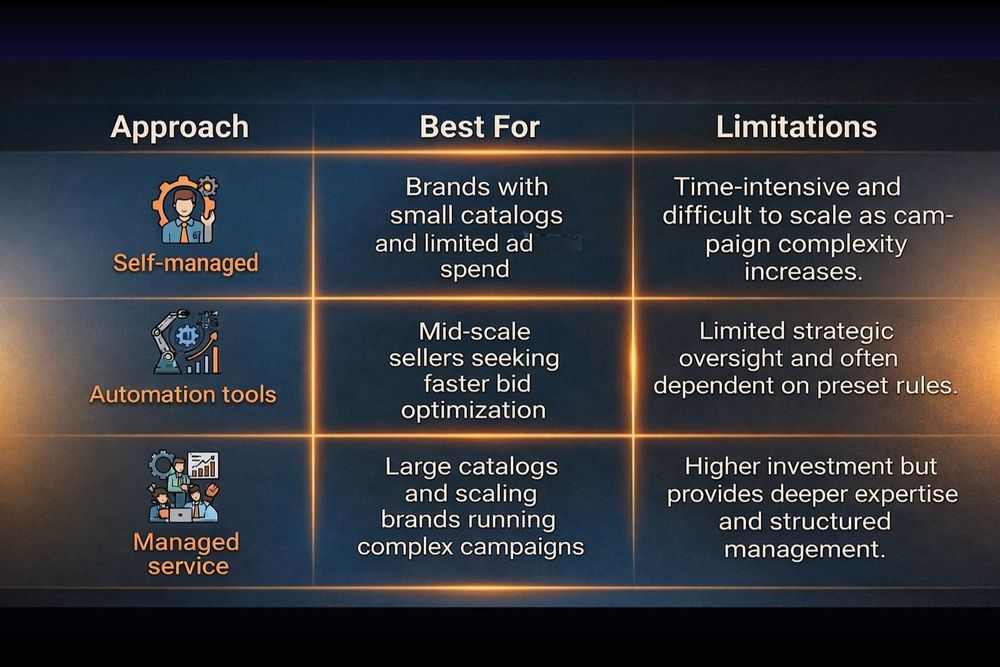
Brands usually manage Amazon advertising through one of three approaches: handling campaigns internally, relying on automation software, or working with a managed service. The right option depends on catalog size, available expertise, and how much operational complexity the team can realistically manage.
As catalogs grow and campaigns multiply, Amazon product advertising management becomes difficult to sustain through manual effort alone. This is why many scaling brands compare self-managed workflows with automation platforms or professional Amazon sponsored products management services.
Why Does Amazon Product Ads Management Become Difficult at Scale?
Amazon product Ads management becomes significantly harder once brands begin managing dozens of ASINs and hundreds of campaigns. What may work for a small catalog quickly becomes inefficient when advertising activity spreads across multiple products, keywords, and audience segments.
As ad spend grows, brands often discover that Amazon product ads campaign management requires far more coordination than expected. Campaigns start interacting with each other, performance becomes harder to interpret, and small inefficiencies across the account can quickly turn into large amounts of wasted spend.
Several operational challenges tend to appear as advertising programs scale:
1. Cross-catalog optimization becomes complex
Advertising performance must be evaluated across multiple ASINs rather than isolated campaigns, making it difficult to understand which products are actually profitable.
2. Rising CPC across competitive categories
As more brands compete for the same keywords, cost-per-click continues to increase, which puts pressure on ACoS and overall profitability.
3. Campaign overlap and keyword duplication
Poor campaign architecture can cause multiple campaigns to compete against each other for the same search terms.
4. Manual bid management reaches its limits
Adjusting bids across hundreds of keywords and campaigns becomes impractical without structured systems or automation.
According to Amazon Ads, more than 2 million small and medium-sized businesses sell on Amazon worldwide, many of which rely on advertising to compete for visibility. As more brands invest in ads across large catalogs, Amazon product advertising management becomes increasingly complex and competitive for sellers managing multiple campaigns.
What Does Professional Amazon Product Ads Management Actually Look Like?
Professional Amazon product ads management operates through structured systems designed to improve performance across an entire product catalog. Instead of focusing on isolated campaigns, it analyzes how different ads, keywords, and products interact with each other. This approach helps brands control spend, maintain profitability, and scale advertising programs with greater consistency.
In practice, Amazon sponsored products management involves coordinating multiple operational elements that influence ad performance. It combines data analysis, campaign strategy, and catalog-level optimization to ensure advertising efforts support broader business goals, not just short-term campaign metrics.
Key responsibilities usually include:
- Campaign architecture: Structured campaign frameworks separate branded, generic, and competitor keywords while organizing campaigns around specific ASIN goals for cleaner Amazon product advertising management.
- Catalog profitability analysis: Advertising performance is evaluated across the entire product catalog to identify which ASINs drive profitable sales and which require optimization.
- Creative and listing alignment: Product listings, images, and content are reviewed to ensure ads send traffic to pages that convert effectively.
- Continuous testing: Campaign performance is constantly monitored through keyword testing, bid adjustments, and experimentation with new targeting strategies.
- Audience segmentation: Advanced Amazon product ads campaign management includes targeting specific audience groups and refining campaigns based on customer behavior and purchase intent.
Top 5 Amazon Product Ads Management Companies in 2026
Amazon product ads management has matured into a specialized discipline and the brands scaling fastest are the ones with dedicated systems behind their advertising operations. Solutions differ widely in how they approach advertising. Some focus on scaling large catalogs, others rely on proprietary technology, and some operate primarily as service-led PPC teams.
Understanding these differences matters for brands evaluating Amazon product advertising management options. The right solution should match your catalog size, operational complexity, and growth goals, because what works for a 10-ASIN brand breaks down fast at 100.
1. Xneeti — AI-Driven Amazon Products Ads Management Built for Scaling Brands
Most sellers reach a point where managing Amazon ads starts feeling like a second full-time job. Bids need constant attention. Keywords pile up, ACoS climbs, and the bigger your catalog gets, the harder it becomes to stay on top of it all. Xneeti was built specifically for this problem by people who have seen it from both sides. Its founders managed Amazon categories from the inside. Its engineers built ad systems at Google that processed billions of signals daily.
The result is a natively built AI platform that handles Amazon product ads campaign management as one connected system, not a patchwork of tools. Every account also gets a dedicated strategist who oversees everything the AI does and communicates directly with you. One person - full ownership. An account-to-manager ratio 50% lower than the industry standard.
On average, brands on Xneeti see a 50% reduction in TACoS and 30% revenue growth, numbers backed by real sellers who rated Xneeti 4.8 on Google and 4.6 on Trustpilot.
Key strengths
- Hourly bid adjustments across ASINs, placements, and campaign types for smarter Amazon sponsored products management.
- OneOS connecting Sponsored Products, Sponsored Brands Video, creative, and catalog-level Amazon product advertising management.
- ASIN-level TACoS and profitability reporting across the full catalog.
- Full-funnel Amazon product ads management from campaign architecture to AMC attribution, backed by B Capital and Good Capital.
2. Teikametrics
Teikametrics is an AI-powered ecommerce advertising platform that helps brands automate bidding, optimize campaigns, and improve profitability through data-driven insights. The platform uses artificial intelligence to adjust bids and budgets dynamically while providing analytics that help sellers scale their Amazon sponsored products management efforts.
Considerations
- Best suited for teams with some internal Amazon PPC familiarity.
- Creative and listing strategy may require additional support outside the platform.
3. Perpetua
Perpetua provides ecommerce advertising software designed to help brands plan, launch, and optimize campaigns across marketplaces such as Amazon and Walmart. The platform focuses on automation and intelligent reporting to help brands measure the impact of Amazon product advertising management spend and improve performance across campaigns.
Considerations
- Teams new to automation may require an onboarding period.
- Strategic Amazon product ads campaign management may still need internal resource support.
4. Pacvue
Pacvue offers an enterprise-level commerce platform designed to manage retail media advertising and performance analytics. It enables brands to control Amazon sponsored products management across search, DSP, and other retail media channels while integrating reporting and optimization tools within a single system.
Considerations
- Platform is designed with larger teams and complex organizational structures in mind.
- Onboarding may benefit from dedicated implementation support.
5. Quartile
Quartile focuses on automation-driven Amazon product ads management, helping sellers scale sponsored products campaigns through AI-powered automation and cross-channel campaign analysis. The platform is known for emphasizing performance optimization and simplifying Amazon product advertising management workflows for ecommerce teams.
Considerations
- Broader marketplace management may require additional tools or resources.
- Best suited for teams prioritizing Amazon product ads campaign management over full operational oversight.
Core Components of Professional Amazon Ads Management
Effective Amazon product Ads management relies on structured campaign architecture, data-driven optimization, and clear visibility across the entire product catalog. When these elements work together, brands can scale advertising efficiently while maintaining control over performance and profitability.
1. Campaign Architecture
Campaign architecture defines how advertising campaigns are organized across products, keywords, and targeting strategies. A clear structure helps prevent campaign overlap and ensures that ad spend is allocated effectively across different ASINs.
2. Keyword and Bid Optimization
Successful Amazon sponsored products management requires continuous monitoring of keywords and bid adjustments based on performance data. This process helps brands maintain visibility for high-converting keywords while controlling costs across competitive search terms.
3. Catalog-Level Profitability Tracking
Catalog-level tracking allows brands to understand how advertising affects the profitability of different products rather than evaluating campaigns in isolation. By analyzing metrics such as ACoS and TACoS across multiple ASINs, brands can make more informed advertising decisions.
4. Continuous Testing and Scaling
Effective Amazon product ads campaign management relies on ongoing testing to identify new opportunities for growth and performance improvement. Brands regularly test new keywords, audience segments, and campaign structures before scaling budgets for the strategies that perform best.
In-House vs AI Partner vs Software Tool — Which Model Works Best?
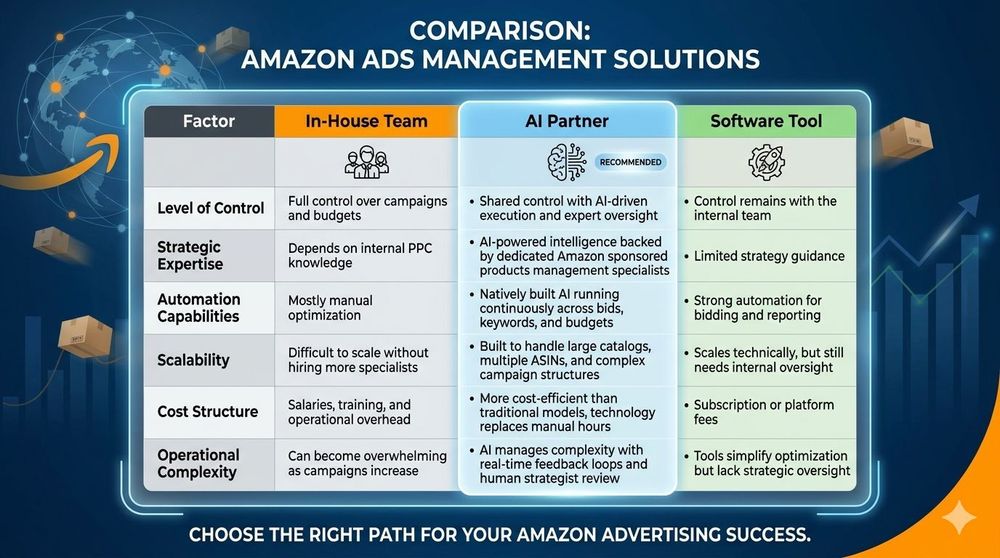
The best approach depends on catalog size, advertising budget, and the expertise available within the team. As advertising programs expand across dozens of campaigns and ASINs, brands often evaluate whether their current Amazon product Ads management model can handle increasing complexity.
Different models support Amazon product advertising management in different ways. Some offer greater operational control, while others provide automation or strategic expertise.
According to Forbes, third-party brands on Amazon often spend 127% more on Sponsored Products advertising than first-party brands to stay competitive in search results. As advertising investment grows, many companies reassess whether in-house teams, agencies, or software platforms can best support their Amazon product Ads management strategy.
When Should Brands Manage Ads In-House?
Managing ads in-house works best for brands with smaller catalogs, limited advertising budgets, and teams that already understand Amazon PPC fundamentals. In these cases, Amazon product Ads management can remain manageable because campaign structures and keyword sets are relatively simple.
When Is an AI-Native Solution the Better Choice?
The decision becomes clearer when brands manage larger catalogs, increase ad budgets, or use complex campaign structures. Purpose-built Amazon product ads management solutions bring structured systems and experienced teams for Amazon sponsored products management, helping brands optimize performance across multiple ASINs and campaigns.
When Do Automation Platforms Make Sense?
Automation platforms are useful when teams want to streamline repetitive tasks such as bid adjustments and performance reporting. These tools support Amazon product ads campaign management by applying algorithm-driven optimization across campaigns while allowing internal teams to focus on strategy.
How Should Brands Evaluate an Amazon Ads Management Partner?
Brands should evaluate an Amazon ads management partner based on operational capability, transparency, and strategic expertise rather than simple performance claims. A reliable partner should demonstrate structured Amazon product Ads management processes that improve campaign efficiency across an entire catalog. The goal is to ensure that Amazon product advertising management supports both revenue growth and long-term profitability.
Questions to Ask Before Hiring
Before choosing a solution, brands should ask questions that reveal how Amazon product ads management is actually handled, operationally, not just in the pitch.
- How do you structure campaigns across large catalogs with multiple ASINs?
- What reporting metrics do you provide for Amazon sponsored products management performance?
- How frequently do you optimize bids, keywords, and campaign structures?
- How do you measure profitability beyond ACoS, such as TACoS or contribution margin?
- What tools or systems do you use for campaign optimization and performance tracking?
Red Flags to Watch For
Certain warning signs may indicate that a solution lacks the systems needed for effective Amazon product ads campaign management.
- Unrealistic promises such as guaranteed rankings or guaranteed sales growth
- No reporting transparency or limited access to campaign performance data
- Long-term lock-in contracts with no clear performance benchmarks or review periods
Key Metrics Professional Amazon Ads Management Should Track
Professional Amazon product Ads management depends on tracking the right performance metrics, not just campaign activity. These indicators help brands understand whether advertising spend is actually driving profitable growth across the catalog.
Below are some of the key performance metrics used in Amazon product advertising management:
1. ACoS (Advertising Cost of Sale)
ACoS shows how much advertising spend is required to generate revenue from ads. It helps brands measure whether campaigns are operating efficiently or consuming too much budget.
2. TACoS (Total Advertising Cost of Sale)
TACoS evaluates the relationship between advertising spend and total sales across the entire catalog. This metric helps brands understand how advertising supports overall business growth, not just ad-driven revenue.
3. Conversion Rate
Conversion rate indicates how effectively product pages turn ad clicks into purchases. Low conversion rates often signal issues with product listings, pricing, or customer trust signals.
4. CPC (Cost Per Click)
CPC measures how much brands pay each time a shopper clicks on an ad. Monitoring CPC helps teams adjust bids and understand the competitiveness of specific keywords.
5. Share of Voice
Share of voice reflects how visible a brand is compared with competitors within search results and advertising placements. Strong visibility often signals effective Amazon product ads campaign management and well-optimized targeting strategies.
The Xneeti Approach to Amazon Product Ads Management
Winning on Amazon today requires more than good campaigns. Auctions shift hourly, Rufus is changing how shoppers discover products, and sellers with faster feedback loops are pulling ahead. Xneeti was built for exactly this environment, every feature developed in-house, from scratch, for how Amazon actually works today.
- One System Connecting Every Part of Your Ad Operation
OneOS brings campaign data, creative assets, inventory signals, and performance insights into one place for seamless Amazon product ads management. There are no disconnected tools, no data gaps, and no guesswork, just one connected system running across your entire catalog.
- Bids That Adjust Every Hour, Not Every Week
Xneeti's AI continuously optimizes bids by hour, day, and placement type for sharper Amazon sponsored products management. Competitor keywords are tracked, wasted spend is eliminated systematically, and negatives are added before the damage ever reaches your ACoS report.
- Every Ad Format, Every Stage of the Funnel
From Sponsored Products to Sponsored Brands Video and DSP, Xneeti covers the full scope of Amazon product advertising management. In-house video creative and AMC integration mean better attribution, stronger creative, and smarter budget decisions, all in one place.
- Answers in Seconds, Not Next Week
Your dedicated strategist reviews everything the AI does and communicates directly with you, making Amazon product ads campaign management feel like having an expert in-house. Ask anything about your account and get a plain-English answer instantly, no support tickets needed.
Is It Time to Upgrade Your Amazon Ads Management?
Brands should consider upgrading their Amazon product Ads management when existing campaign structures can no longer keep pace with catalog growth and advertising complexity. As campaigns expand, manual management often becomes inefficient, and performance insights become harder to interpret.
Some common signals indicate that Amazon product advertising management may need a more structured approach:
- Rising ACoS across campaigns: Increasing ACoS can indicate inefficient bidding strategies, poor keyword targeting, or campaign overlap.
- Scaling product catalogs: As brands add more ASINs, managing campaigns individually becomes difficult without structured systems.
- Limited advertising visibility: Without clear reporting, teams may struggle to understand which products, keywords, or campaigns are driving results.
Amazon’s advertising business is expanding rapidly, with ad sales reaching $17.7 billion in a single quarter and growing 24% year-over-year, showing how quickly competition for sponsored placements is increasing on the platform. As advertising activity scales this fast, many brands upgrade their Amazon product Ads management to maintain visibility and control campaign performance.
Final Thoughts
For many brands, the difference between plateauing and scaling often comes down to how well their Amazon product Ads management is structured. As advertising becomes more competitive and catalogs expand, managing campaigns through manual adjustments alone rarely delivers consistent results.
Optimize Your Amazon Advertising With Xneeti
Xneeti’s brings structure, visibility, and smarter optimization to Amazon product advertising management, helping brands manage campaigns across their entire catalog with greater clarity. Book a demo with Xneeti to see how a systems-driven approach can support your next stage of growth.


